
Web3 gaming in 2026 is no longer a simple story of hype or collapse. For years, the sector was promoted as the future of digital ownership, player-driven economies, and open in-game assets. At the same time, critics argued that most blockchain games were just weak products wrapped in token speculation. In 2026, the truth sits somewhere in the middle. Web3 gaming is still alive, still attracting activity, and still pulling in investor attention, but it has clearly lost the explosive momentum that once made it look unstoppable.
The real issue now is not whether Web3 gaming exists. It does. The real issue is whether it is becoming a durable part of the gaming industry or simply surviving inside a smaller crypto-native niche. That is an important difference, because high attention during a hype cycle is not the same as sustainable growth. As we explained in our Web3 retention reality check, long-term adoption in Web3 always comes down to whether users stay when speculation fades.
Quick Facts: Web3 Gaming in 2026
- Daily active wallets peaked around 5.8M in 2025
- Activity later dropped to around 4.8M
- Gaming remains one of the biggest Web3 sectors
- Market forecasts still point to long-term growth
- Biggest weakness: retention, not awareness
What the real user data says about Web3 gaming in 2026
The best way to judge the sector is to ignore slogans and look at actual activity. According to DappRadar’s State of Blockchain Gaming in Q1 2025, blockchain gaming activity reached 5.8 million daily unique active wallets in Q1 2025. By Q2 2025, DappRadar reported that activity had dropped 17% quarter over quarter to 4.8 million daily unique active wallets, the lowest level since early 2023. That same Q2 report also noted that more than 300 gaming dapps went inactive during the quarter.
Those numbers matter because they tell a more honest story than either side of the argument wants to admit. Web3 gaming did not collapse. But it also did not continue the kind of breakout growth that the strongest believers expected. The sector looks more like a market that has exited the pure hype phase and entered a much tougher phase where product quality, retention, and usability matter far more than headlines.
Why growth momentum in blockchain gaming has slowed
The biggest problem is not just user decline. It is the loss of momentum. During the earlier cycle, many projects could attract users through token rewards, NFT speculation, and financial upside. That made growth look stronger than it really was. Once market sentiment cooled, many of those same projects struggled to keep players active. DappRadar’s Q2 2025 report captured this clearly by showing lower activity, more inactive gaming dapps, and rising pressure on projects that depended on constant hype or unsustainable economies.
This pattern is not unique to gaming. Across Web3, sectors that rely too much on short-term financial incentives often struggle to keep users once rewards weaken. That is why practical utility matters so much. In areas where blockchain solves a clearer problem, such as how stablecoins are used for cross-border payments or basic infrastructure topics like what do blockchain nodes actually do, repeat usage is easier to defend because the product serves a function beyond speculation.
Web3 gaming market size vs real user adoption
This is where the story becomes more complicated. While wallet activity cooled in 2025, market forecast reports still project long-term growth for the sector. A Research and Markets Web3 gaming report values the market at $48.55 billion in 2026 and projects it could reach $108.08 billion by 2030. Another market forecast from Straits Research places the sector at $28.31 billion in 2025 with long-term growth continuing through the next decade. Forecast reports should always be read carefully because different firms use different definitions and assumptions, but they all point to the same broad conclusion: capital still believes Web3 gaming has significant upside.
That creates a visible split in the sector. On one side, investors still see future growth. On the other side, real user activity shows a market that is stable at best and still struggling to prove mainstream product strength. In simple words, the money is still optimistic, but the users are demanding better games before they fully commit.
| Metric | What It Shows |
|---|---|
| Daily active wallets | Real usage is still significant, but growth has slowed |
| Market forecasts | Investors still see long-term upside |
| Retention | Many projects still struggle to keep players engaged |
| Mainstream adoption | Still weak compared to traditional gaming |
| Sector direction | Moving from speculation toward product quality |
Who is actually using Web3 games today?
The current audience is still much narrower than many headlines suggest. A meaningful share of Web3 gaming activity continues to come from crypto-native users, NFT traders, and communities already comfortable with wallets, tokens, and onchain systems. That is very different from winning over mainstream console, PC, or mobile gamers who care first about smooth gameplay, strong content, fair progression, and low friction. DappRadar also notes that daily unique active wallets are not the same thing as unique human players, because many users operate more than one wallet.
This gap matters because most mainstream gamers do not want to think about gas fees, wallet approvals, private keys, or whether an in-game asset economy can collapse in a few months. They want a good game. That is why scaling and user experience are so important. Technologies discussed in Layer-1 vs Layer-2 blockchains explained are directly relevant here, because lower fees and faster transactions can remove some of the friction that still keeps blockchain gaming from feeling invisible to regular players.
Why most Web3 gaming projects still fail
Most weak Web3 games fail for the same reasons. First, many game economies are not sustainable. They rely too heavily on emissions, token rewards, or speculative asset demand. Second, too many projects put earning mechanics ahead of fun. If the core game is weak, financial incentives can only hide that problem for a limited time. Third, retention is often poor. Many players show up for rewards, not because the game itself is strong enough to keep them engaged. Fourth, some projects raised large amounts of money during stronger market conditions but struggled to deliver quality products at the level users expected. DappRadar’s Q2 2025 report, which recorded more than 300 inactive gaming dapps, reflects how severe that pressure became once hype cooled.
You can see similar friction in other parts of crypto where usability and trust still matter more than theory. For example, users thinking about self-custody often hesitate because of the practical risks explained in Hot Wallet vs Cold Wallet. In gaming, that same hesitation becomes even stronger, because players are comparing blockchain experiences with polished traditional games that already work smoothly.
The shift from play-to-earn to better game design
The positive development is that the sector does appear to be evolving. The loudest phase of pure play-to-earn has weakened. In its place, more builders are trying to focus on gameplay-first design, digital ownership, smoother onboarding, cross-platform access, and blockchain features that improve the user experience without dominating it. That is a healthier direction, because it moves the industry away from speculation-first mechanics and closer to product-first design.
The strongest long-term version of Web3 gaming is probably not one where every player becomes a trader. It is one where blockchain works quietly in the background, helping with ownership, marketplaces, identity, creator incentives, or digital asset portability, while the player mainly notices that the game itself is good. Broader Web3 infrastructure trends may also shape that future. Themes explored in The Internet of Agents show how autonomous systems, onchain transactions, and digital economies could eventually influence game environments as well. But none of that matters if the actual gameplay remains weak.
Web3 gaming in 2026 is no longer trying to prove that tokens can attract users. It is trying to prove that blockchain can support games people actually want to keep playing.
Is Web3 gaming dead or rebuilding in 2026?
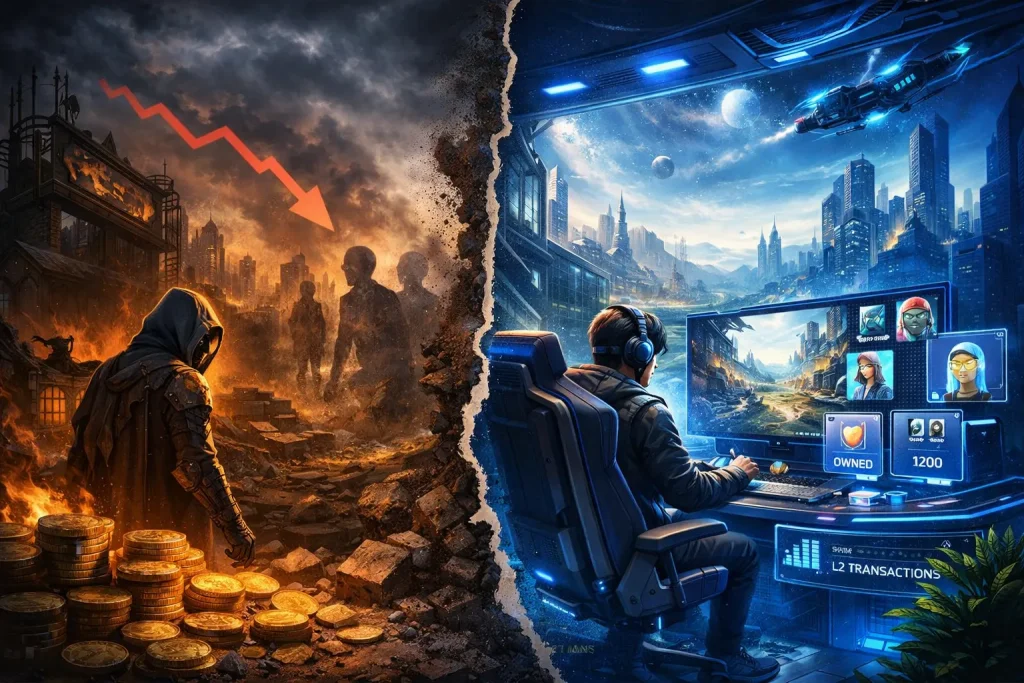
The most honest answer is that Web3 gaming is rebuilding, not booming and not dead. The hype cycle already happened. The easy capital and easy narratives already happened. The correction also happened. Now the sector is in the difficult middle stage where better infrastructure alone is not enough and products have to stand on their own. That is why the current state of Web3 gaming can be described as real infrastructure, but uneven product quality.
If better games arrive, if wallets become almost invisible, if in-game economies become more stable, and if users feel genuine value from asset ownership rather than forced tokenization, then Web3 gaming could still become a major long-term category. But if most projects continue treating blockchain as a substitute for strong game design, then the sector will remain stuck inside a loud but limited niche.
Key Takeaways
- Web3 gaming is not dead, but it is no longer in hype mode
- User activity shows stabilization, not breakout growth
- Investor interest remains stronger than player conviction
- Weak gameplay and unstable token economies still hurt adoption
- The next growth phase depends on better products, not louder narratives
What to watch next
The next 12 to 24 months will likely decide whether Web3 gaming becomes a serious long-term category or remains a niche crypto segment. The biggest signals to watch are stronger retention, better onboarding, lower transaction friction, more gameplay-first releases, and whether larger studios can ship products that appeal beyond crypto-native use
Final verdict on the future of Web3 gaming
Web3 gaming is not dead in 2026. It still has millions of active wallets, still attracts investors, and still remains one of the most visible segments inside the onchain ecosystem. But it is also not yet the mainstream gaming revolution that early narratives promised. Recent DappRadar reports show real activity, but they also show clear pressure on growth, retention, and project survival.
The next stage will not be decided by bigger promises. It will be decided by better products. If the sector can combine low-friction infrastructure with genuinely enjoyable games, then Web3 gaming may still have a major future. If not, it will continue to exist mostly as a crypto-native experiment that never fully crossed into the wider gaming market.
In other words, Web3 gaming’s future will not be decided by token hype. It will be decided by whether blockchain can finally disappear into the background while better games take the spotlight.
Why this matters
Web3 gaming matters beyond the gaming niche because it tests some of the biggest promises in blockchain: digital ownership, interoperable assets, community economies, and low-friction onchain experiences. If gaming cannot turn those ideas into strong consumer products, it becomes harder for the wider Web3 industry to prove that blockchain improves mainstream digital experiences.
❓ FAQ
Is Web3 gaming growing in 2026?
Web3 gaming is still active in 2026, but growth is much slower than during the peak hype period. Recent data points to stabilization after declines rather than a return to explosive expansion.
How many people use Web3 games?
Recent DappRadar reports placed blockchain gaming around 5.8 million daily unique active wallets in Q1 2025 and about 4.8 million in Q2 2025. Those figures measure wallet activity, not necessarily unique individual players.
Why did Web3 gaming lose hype?
The biggest reasons were weak retention, unsustainable token economies, too much focus on earning mechanics, and gameplay that often was not strong enough on its own.
Can Web3 gaming still succeed?
Yes, but only if the product improves. Better gameplay, lower friction, more stable economies, and easier onboarding matter far more now than token narratives alone.
Is Web3 gaming competing with traditional gaming yet?
Not at a serious mainstream level. Right now, it is still trying to prove it can offer experiences strong enough to stand beside established Web2 games rather than only appeal to crypto-native users.
After you paste this, set all external links to dofollow in WordPress/Rank Math, and make sure your featured image alt text includes Web3 gaming in 2026.
