

Institutional adoption Web3 is no longer just a future narrative. It is already changing how the crypto market works, how blockchain infrastructure is built, and which parts of Web3 are gaining long-term traction. Chainalysis said in late 2024 that Web3’s next growth wave was being led by stablecoins, TradFi engagement, and tokenization, not only by speculative cycles.
For years, Web3 was driven mostly by retail speculation, early developer communities, and crypto-native experimentation. That phase mattered, but the market is evolving. Today, institutional adoption Web3 is increasingly visible in stablecoin settlement, tokenized assets, digital custody, blockchain payments, and regulated onchain infrastructure. McKinsey wrote in July 2025 that tokenized cash and stablecoins are opening the door to next-generation payments, especially where faster and more programmable rails improve real-world financial processes.
If you already read our guides on stablecoins for remittances, what is yield farming, validators explained, common crypto scams beginners must avoid, and why institutions are interested in tokenized finance, this article shows how institutional adoption Web3 changes the market itself.
What Institutional Adoption Web3 Really Means
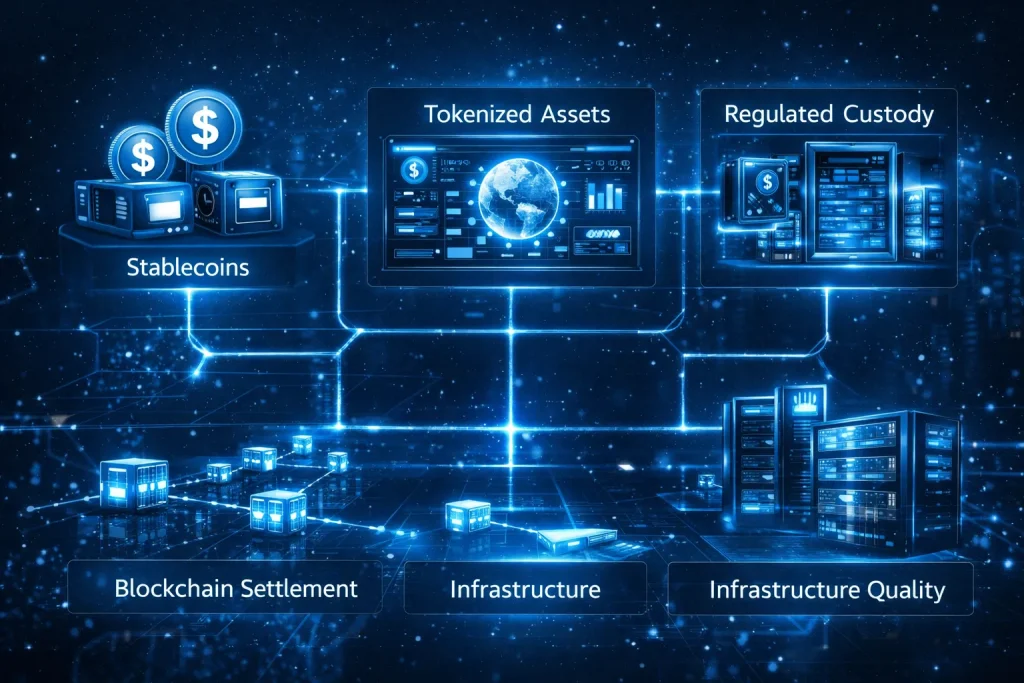
Institutional adoption Web3 refers to banks, asset managers, payment firms, funds, and regulated service providers using blockchain-based systems in serious ways.
That can include:
- stablecoin settlement
- digital asset custody
- tokenized funds and tokenized treasuries
- blockchain payment rails
- compliance-focused infrastructure
- regulated onchain financial products
This is different from retail participation. Retail users often move faster and follow narrative cycles. Institutions usually move slower, but when they move, they raise the bar for infrastructure, compliance, reporting, and operational quality.
1. Stablecoins Become More Important Than Speculation
One of the biggest effects of institutional adoption Web3 is that stablecoins become far more central to the market.
Stablecoins fit institutional needs better than many speculative tokens because they can be used for payments, treasury movement, settlement, and programmable cash. Visa says stablecoins can modernize digital payments and support innovative onchain financial solutions, especially as regulatory clarity improves. You can see that in Visa’s stablecoins and the future of onchain finance overview.
This trend is already visible in market size. RWA.xyz market overview currently shows about $299.30 billion in total stablecoin value and more than 241 million stablecoin holders.
That matters because institutional adoption Web3 pushes the market toward assets that behave more like financial infrastructure than speculative chips.
2. Tokenization Gets Taken More Seriously
Another major effect of institutional adoption Web3 is that tokenization moves from theory toward implementation.
McKinsey defines tokenization as the digital representation of a real thing, including financial assets such as cash, funds, treasuries, and credit products. That is why tokenization has become one of the most serious institutional themes in Web3. See McKinsey’s payments analysis on tokenized cash.
The asset side is already large enough to matter. RWA.xyz market overview currently reports about $26.67 billion in distributed asset value and nearly 700,000 asset holders across tokenized real-world asset markets.
This changes Web3 because tokenization attracts participants who care less about memes and more about settlement, collateral, reporting, and transfer efficiency.
3. Regulation Starts Mattering More Than Narrative
As institutional adoption Web3 grows, regulation becomes much more central to market structure.
Institutions care about custody rules, reserve quality, disclosures, licensing, redemption rights, and compliance controls. Markets driven mostly by retail attention can sometimes ignore those issues for a while. Institutions usually cannot. Chainalysis said in its 2025 crypto regulatory round-up that 2025 brought major regulatory developments across regions and that those shifts would shape 2026 adoption.
This does not mean regulation removes risk. It means institutional adoption Web3 tends to reward sectors that can function inside clearer legal and operational frameworks.
4. Infrastructure Quality Becomes a Bigger Advantage
One of the clearest signs of institutional adoption Web3 is that weak infrastructure becomes harder to tolerate.
Institutions care about uptime, auditability, wallet controls, settlement quality, counterparty design, and operational resilience. Visa’s broader stablecoin materials also emphasize partner networks, scalable settlement, and real-world payment reach. See Visa’s stablecoins page.
This means the market starts valuing backend quality more seriously. Custody systems, validator infrastructure, analytics, treasury tools, and settlement rails all become more important as institutional adoption Web3 grows.
5. The Market Starts Looking Less Retail-Only
When institutional adoption Web3 increases, the market mix changes.
That does not mean volatility disappears. It means more activity becomes tied to payments, tokenized assets, treasury operations, and settlement systems instead of only speculative attention. Chainalysis specifically highlighted stablecoins, TradFi engagement, and tokenization as major drivers of Web3’s next phase. Read Chainalysis’ Web3 growth opportunities piece.
This is a major shift because a market built only on speculation behaves differently from a market that also includes real financial utility.
6. Web3 Starts Looking More Like Financial Plumbing
A mature form of institutional adoption Web3 often looks less dramatic on the surface, but more important underneath.
Instead of focusing only on visible hype cycles, the market starts building more invisible infrastructure:
- settlement rails
- stablecoin treasury systems
- tokenized collateral flows
- regulated custody
- payment integrations
- reporting and compliance layers
McKinsey’s 2025 work on stablecoins argues that tokenized cash is becoming more relevant inside the broader payments ecosystem, not just within crypto-native markets. That is why institutional adoption Web3 can make Web3 more embedded and less theatrical over time. See McKinsey’s full piece here.
7. Payment Firms and Financial Brands Gain More Influence
Another effect of institutional adoption Web3 is that large payment companies and financial brands begin shaping which blockchain use cases scale.
As more major firms build or integrate blockchain products, they influence which chains, standards, and settlement rails get real traction. Visa’s materials say stablecoins can give banks faster liquidity, faster treasury movement, and new money-movement models. That is a very different signal from a purely retail-led market phase. See Visa’s stablecoin infrastructure page.
8. Utility-Driven Projects Gain a Stronger Edge
Institutional adoption Web3 usually favors sectors with practical use.
That often includes:
- stablecoin payments
- tokenized treasuries
- tokenized funds
- blockchain settlement
- digital asset custody
- analytics and compliance tools
- infrastructure with strong uptime and security
This is why institutional participation often benefits projects with real utility more than projects built mainly on short-term excitement.
9. The Meaning of Web3 Maturity Changes
Perhaps the biggest shift is that institutional adoption Web3 changes how people define market maturity.
For a long time, many people judged Web3 health mostly by token prices, memecoin activity, or retail trading volume. But a more mature market is increasingly measured by stronger rails, tokenized real-world assets, regulated payment systems, and durable financial use cases. The McKinsey and Chainalysis research both point in that direction.
That does not make retail irrelevant. It means Web3 now has another growth engine beyond speculation.
Does Institutional Adoption Web3 Automatically Make the Market Better?
Not automatically.
Institutional participation can improve infrastructure, increase liquidity, and accelerate real-world use cases. But it can also increase concentration, strengthen gatekeeping, and shift power toward a smaller number of large players.
So the real question is not whether institutional adoption Web3 is simply good or bad. The better question is whether this phase can expand utility without weakening decentralization too much.
Final Thoughts on Institutional Adoption Web3
Institutional adoption Web3 changes the market by shifting attention from hype toward infrastructure, stablecoins, tokenization, and compliance-ready financial systems.
Stablecoins become more important. Tokenization becomes more credible. Infrastructure quality becomes more valuable. And projects with real-world use cases gain a stronger edge over projects built only on short-term narratives.
This does not mean Web3 becomes less innovative. It means the center of gravity changes. The next phase of crypto may be defined less by noise and more by whether blockchain systems can support real financial activity at scale
FAQ
What does institutional adoption mean in Web3?
It means large financial firms, payment companies, banks, funds, and regulated service providers are using or building blockchain-based products and infrastructure.
Why is institutional adoption important for Web3?
Because institutions bring capital, compliance requirements, infrastructure standards, and real-world use cases that can change how the market develops.
How do stablecoins benefit from institutional adoption?
Stablecoins fit institutional needs for payments, treasury movement, settlement, and programmable cash better than many speculative crypto assets.
How does tokenization change the Web3 market?
Tokenization brings real-world assets like treasuries, funds, and credit products onto blockchain rails, which expands Web3 beyond purely speculative use cases.
Does institutional adoption remove crypto volatility?
No. But it can change the market mix by increasing activity tied to payments, infrastructure, and tokenized assets rather than only speculation.
