
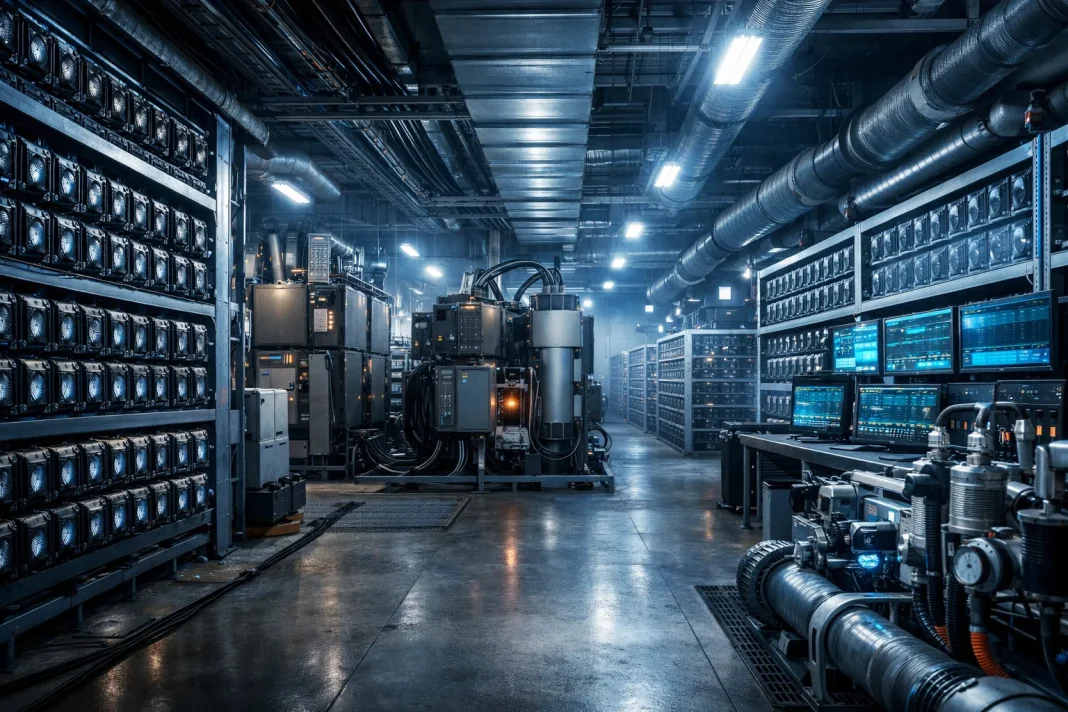
When most people imagine a Bitcoin mining facility, they picture endless rows of machines in a loud warehouse producing BTC around the clock.
That image is incomplete.
• Real competitiveness depends on uptime, thermal control, maintenance speed, and electrical stability.
• Cheap electricity alone does not guarantee good mining economics.
• The best operators win by reducing hidden downtime across the full operating stack.
A real industrial Bitcoin mining facility in 2026 is not just a room full of ASICs. It is a tightly managed power-and-cooling system where uptime, electrical stability, thermal control, maintenance discipline, and fast failure response matter just as much as raw hashrate.
That is the difference between internet-level mining theory and real-world mining operations.
At small scale, mining is mostly about hardware and electricity price. At industrial scale, it becomes an infrastructure business. Operators have to think about transformers, switchgear, airflow design, immersion systems, firmware consistency, curtailment, network monitoring, pool strategy, and repair logistics. If any one of those layers fails, the site loses efficiency or goes offline.
This is why modern Bitcoin mining facilities should be understood less like hobby setups and more like specialized energy-backed compute sites built to convert power into hashpower as efficiently as possible.
If you are new to the deeper mechanics behind mining itself, it helps to first understand how Bitcoin hashing, SHA-256, and mining security work. But once the theory is clear, the bigger question becomes much more practical: what actually makes a mining facility work or fail in the real world?
A Bitcoin mining facility is really a power conversion business
Most beginner guides describe mining facilities as places that “run lots of ASIC miners.” That is technically true, but it misses the real operating model.
A serious mining site is built around one loop:
power comes in, infrastructure distributes it, machines convert it into hashpower, pools convert that hashpower into payouts, and operators try to protect margin by reducing downtime, heat stress, and wasted energy.
That is why large facilities are usually chosen based on power access first, not on brand image or geography alone. Operators want electricity that is not only cheap, but also stable, scalable, and operationally usable.
This point matters more than many people realize. In practice, “cheap electricity” is not enough if the site suffers from unstable voltage, poor protection design, weak transformer planning, or frequent shutdown events. A mining site with slightly higher energy cost but better reliability can outperform a theoretically cheaper site that keeps losing uptime.
That operational reality is one reason industrial mining is far more complex than the simplistic “plug in miners and collect BTC” image that still circulates online.
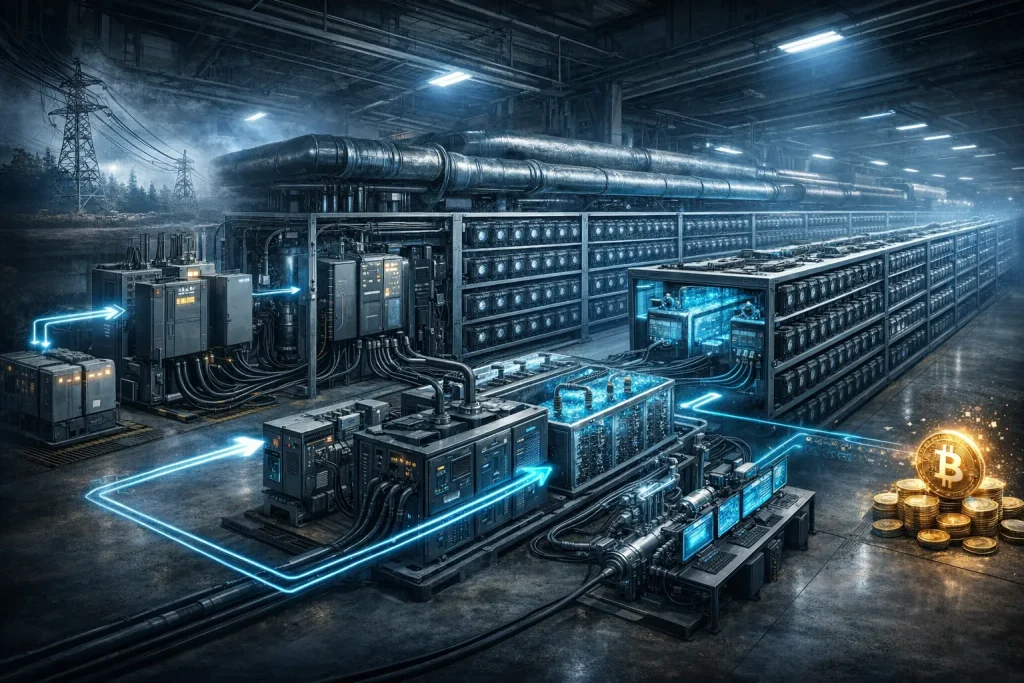
Industrial mining is not just a hardware business. It is an uptime business.
The ASICs are only the visible layer
The miners are the most obvious part of the facility, but they are not the whole business.
A modern industrial site usually depends on several hidden layers working together:
- power intake and voltage transformation
- switchgear and electrical protection
- breaker distribution and cable management
- cooling architecture
- environmental filtration
- networking and remote monitoring
- fleet management software
- repair workflow and spare parts rotation
When people outside the industry compare facilities, they often focus only on machine model and terahash numbers. Operators know that infrastructure quality often matters more.
A site can have strong hardware and still perform badly if airflow is poor, heat is trapped, filters are neglected, networking is unstable, or failed units are not swapped quickly enough. Industrial mining is not just about owning machines. It is about keeping the full system healthy under constant electrical and thermal stress.
That is also why mining economics should never be judged by machine specs alone. Real profitability depends on uptime, infrastructure losses, repair cycles, and site efficiency, which is exactly why this topic connects naturally with our guide on whether Bitcoin mining is still profitable in 2026.
Power quality matters as much as power price
Electricity is usually the biggest operating expense in mining, but it is also more than an expense. It is the operating environment itself.
Many weak analyses reduce the discussion to one number: cost per kilowatt-hour. Real operators look at a wider picture:
- voltage stability
- transformer capacity
- load balancing
- fault isolation
- restart behavior after power events
- contractual flexibility
- curtailment exposure
- ability to scale without creating new failure points
This is where industrial mining starts to look much more like heavy infrastructure than internet culture.
A mining site with unstable power may face repeated restarts, overheating events, breaker trips, hardware wear, and maintenance drag that destroy the savings from a headline electricity rate. In contrast, a site with disciplined electrical design can protect uptime and reduce hidden losses across thousands of machines.
In some regions, mining facilities are also treated as flexible industrial loads that may be asked to reduce consumption during periods of grid stress. That is one reason the broader industry now pays close attention to site geography, load flexibility, and grid relations. For readers who want to go deeper into how mining is distributed globally, the Cambridge Bitcoin Mining Map is one of the best references available, and its methodology page helps explain how mining-location estimates are built.
Cooling is where industrial mining becomes real
Heat is not a side issue in Bitcoin mining. It is one of the core operational problems.
Every ASIC turns electricity into both computation and heat. At industrial scale, that heat must be removed continuously or performance collapses. That is why cooling design is one of the biggest differences between a professional facility and a weak one.
Air-cooled sites remain common because they are simpler to deploy, but they can struggle in dusty environments, hot climates, or dense layouts. As fleets become larger and more power-dense, thermal management becomes harder, not easier.
This is one reason immersion and advanced liquid-cooling systems keep attracting attention across the mining sector. They are not just high-tech extras. They can reduce thermal stress, improve consistency, lower fan-related wear, and create more stable performance at higher density. That is also why serious readers should look beyond surface-level mining explainers and pay attention to the infrastructure side of the business.
If you want a broader industry view, the Cambridge Digital Mining Industry Report is useful for understanding how professional mining operations continue to evolve.
Downtime is the hidden killer of mining economics
Many people estimate mining revenue as if machines run perfectly 24/7.
Real facilities do not.
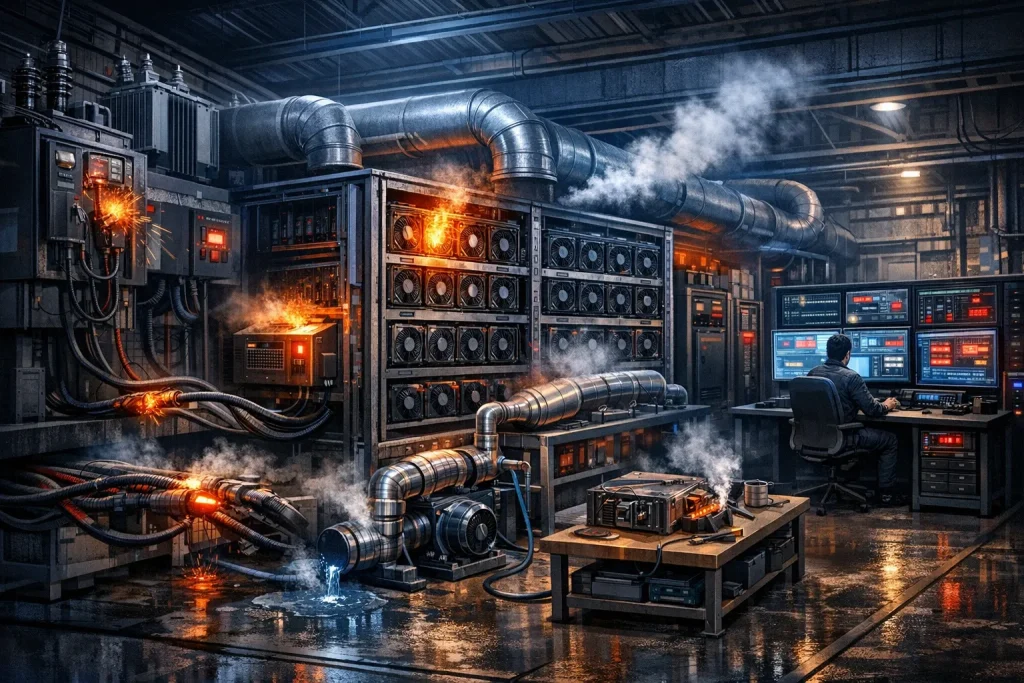
Downtime comes from everywhere: PSU failures, control issues, breaker events, firmware bugs, over-temperature alarms, clogged filters, pump problems, network outages, maintenance windows, human error, and curtailment.
This is where industrial mining becomes far more interesting than generic content. The strongest operators are not just buying newer machines. They are reducing lost minutes and lost hours across the whole site.
That usually means focusing on:
- fast fault detection
- standardized maintenance routines
- spare inventory planning
- remote alerting
- repair triage
- stable firmware deployment
- clear escalation procedures
- performance tracking by batch, row, or container
A site that loses too much uptime may look impressive on paper but perform poorly in practice. A slightly less flashy site with better maintenance discipline can often produce better real-world returns.
That is also why choosing a pool is only one layer of the system. Pool strategy matters, but it cannot save a badly managed site. For readers who want the payout side explained more clearly, it fits well to read our guide on mining pools and why solo mining is almost impossible today.
The modern facility is becoming a full operating stack
One of the biggest shifts in industrial mining is that the competitive edge has moved beyond hardware alone.
Mining in 2026 is increasingly about controlling more of the stack:
- energy procurement
- site design
- cooling systems
- firmware optimization
- fleet monitoring
- repairs and replacement logistics
- treasury strategy
- load management during changing market conditions
That shift is one reason the most important mining businesses today look less like simple hardware owners and more like infrastructure operators.
A useful outside perspective on that broader trend is Hashrate Index’s mining industry review, which highlights how power markets, fleet efficiency, operational strategy, and capital structure now matter as much as machine deployment itself.
That is why industrial mining facilities should not be seen as passive warehouses. The best ones are active optimization systems.
They are built to manage volatility in energy costs, shifts in network difficulty, hardware failures, heat stress, and changing market margins. In other words, they do not just host miners. They continuously adapt.
Sustainability and grid relationships are now part of the story
The public conversation around Bitcoin mining often swings between two extremes: either it is framed as a pure environmental problem or as a perfectly efficient use of stranded energy.
The truth is more complicated.
A professional mining site now has to think about more than machines and revenue. It also has to think about energy sourcing, grid participation, regulatory transparency, and public credibility. In markets where power systems are under stress, flexible mining loads may become both economically useful and politically sensitive at the same time.
That makes mining-facility design more strategic than it was a few years ago. Long-term winners are likely to be the sites that manage power relationships intelligently, not just the sites that chase the cheapest short-term rate.
For readers who want the deeper energy context, this article should also point naturally to our full breakdown of Bitcoin mining energy consumption.
What separates a strong facility from a weak one?
A strong mining facility usually does many small things right:
- it has disciplined electrical planning
- it handles heat efficiently
- it detects faults quickly
- it standardizes maintenance
- it minimizes restart chaos after power events
- it tracks uptime carefully
- it keeps hardware turnover under control
- it adapts to changing grid and market conditions
A weak facility may still look good in photos, but real performance tells the truth. It overheats too often, accumulates avoidable failures, loses hours to preventable issues, and mistakes installed capacity for actual operating efficiency.
Here is the simplest way to understand it:
| What many readers imagine | What a real industrial site actually deals with |
|---|---|
| Plug in miners and earn BTC | Stabilize power, heat, uptime, and maintenance |
| Hashrate is everything | Uptime and site efficiency matter just as much |
| Cheap power solves the business | Bad infrastructure can destroy cheap-power advantage |
| More machines means more profit | Poor cooling and downtime can wipe out scale benefits |
| Mining is just hardware | Mining is hardware plus energy plus operations |
That is one of the biggest hidden lessons in industrial mining: headline hashrate is not the same thing as dependable production.
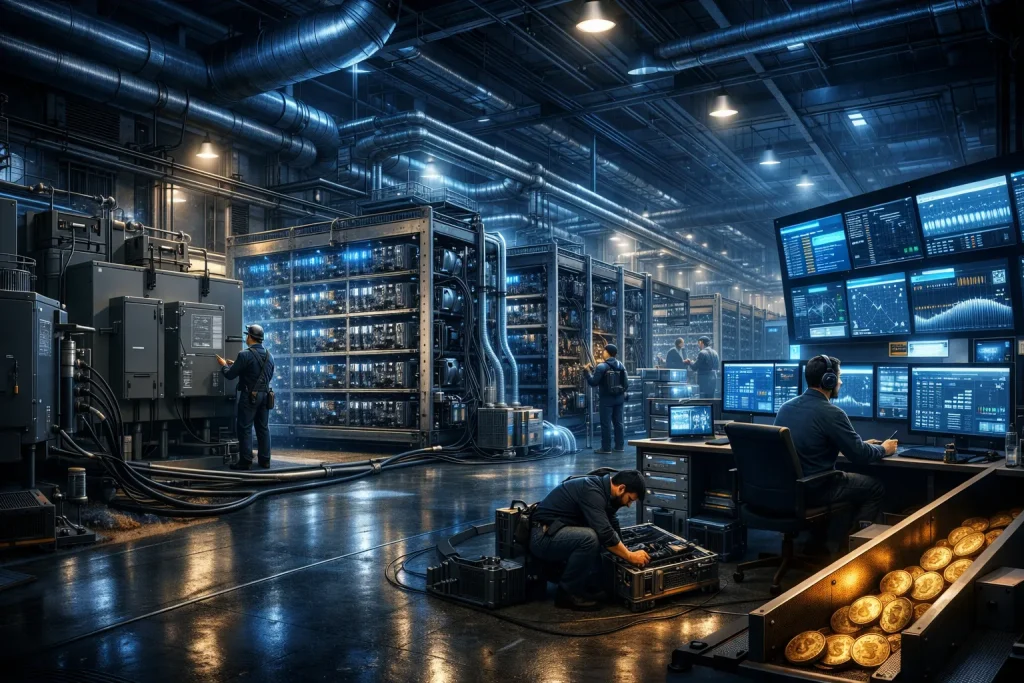
• Clean airflow design
• Fast maintenance cycles
• Continuous monitoring
• Lower downtime losses
• Heat buildup zones
• Slow repair response
• Poor monitoring discipline
• High downtime drag
Why mining facilities matter to Bitcoin itself
Industrial facilities are not just private businesses chasing revenue. They are part of Bitcoin’s real-world security base.
Every professional site that keeps machines online contributes hashpower to the network, supports block production, and strengthens proof-of-work competition. That means better facilities do not just benefit operators. They also shape the economics and resilience of the wider Bitcoin mining ecosystem.
That is one reason readers who finish this piece should continue into our article on why Bitcoin mining difficulty keeps rising over time. Difficulty is not just a chart. It is the protocol-level reflection of real facilities, real machines, and real competition.
And for anyone who wants to turn this theory into numbers, the practical next step is using our BTC Mining Calculator to model how hardware efficiency, electricity cost, and uptime affect the economics.
Final thoughts
The biggest mistake people make when thinking about Bitcoin mining facilities is assuming they are simply large rooms filled with ASICs.
They are not.
A modern facility is an industrial system where power quality, cooling design, maintenance discipline, operational uptime, and intelligent load management all shape the final outcome. Machines matter, but infrastructure decides whether those machines actually perform.
That is the real face of industrial Bitcoin mining in 2026.
Not just noise. Not just racks. Not just terahash numbers.
A true Bitcoin mining facility is a live operating environment that has to survive heat, failure, electrical stress, grid pressure, and thin margins every single day.
That is where industrial mining stops being a theory and becomes a real business.
FAQ
What is a Bitcoin mining facility?
A Bitcoin mining facility is a specialized industrial site that powers, cools, monitors, and maintains large numbers of ASIC miners used to secure the Bitcoin network and produce hashpower.
Why is cooling so important in a mining facility?
Cooling is critical because ASIC miners generate large amounts of heat. Poor thermal control can cause instability, lower efficiency, shorten hardware life, and increase downtime.
Is cheap electricity enough to make a mining facility successful?
No. Cheap power helps, but power quality, uptime, maintenance, cooling design, and operational discipline are just as important for real profitability.
Why do large mining facilities dominate Bitcoin mining?
Large facilities can usually secure better infrastructure, better energy contracts, stronger maintenance routines, and higher uptime, which gives them major operational advantages over small setups.
How do mining facilities affect Bitcoin itself?
Mining facilities contribute real-world hashpower to the Bitcoin network, which supports proof-of-work security and helps validate transactions.
