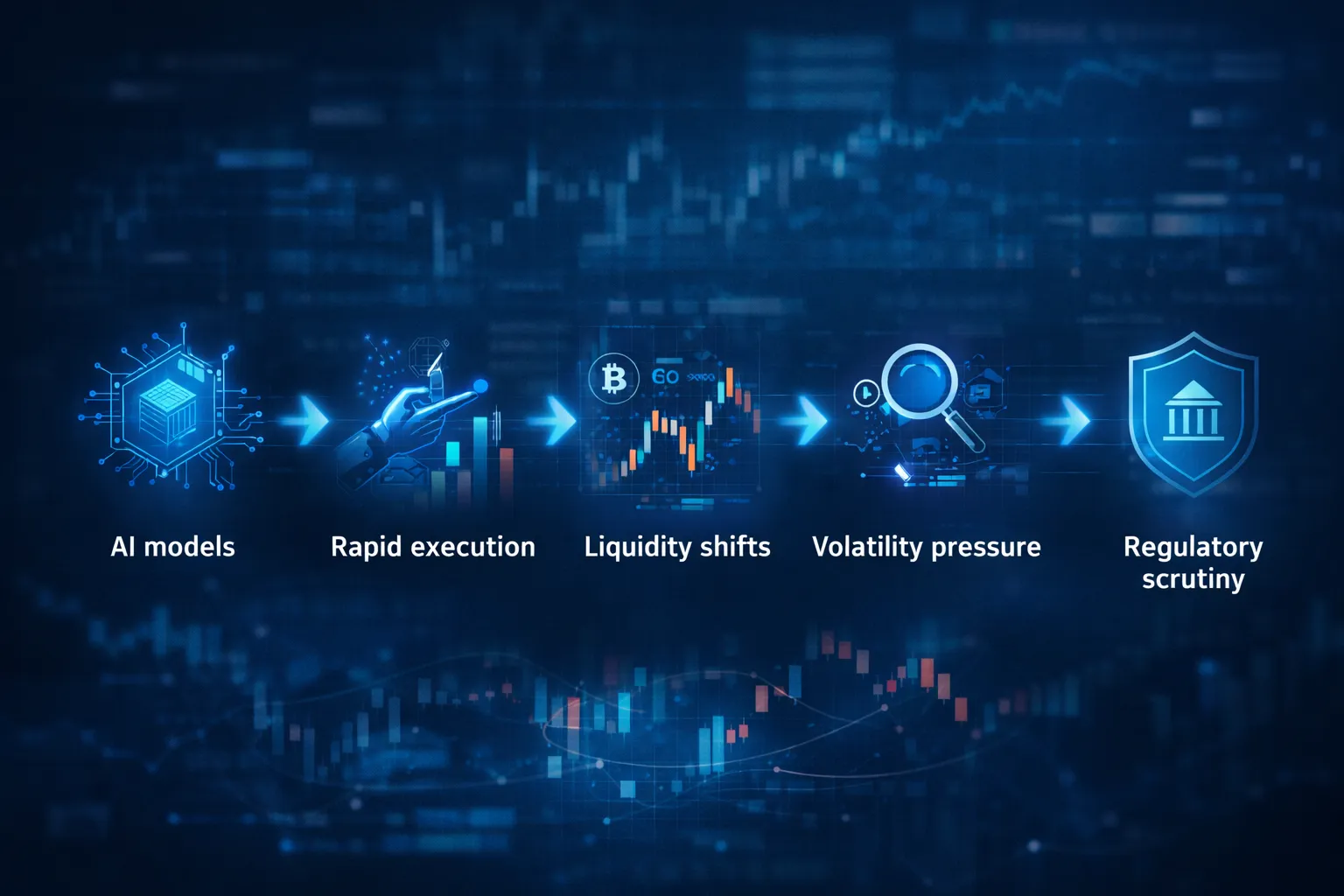
As AI becomes more embedded in exchange infrastructure, regulators are focusing more closely on oversight and accountability.
Artificial intelligence is moving deeper into crypto trading infrastructure, but regulators are becoming increasingly uncomfortable with how fast that shift is happening.
Across global financial markets, supervisory bodies are paying closer attention to how AI is being used in trading, surveillance, execution, and market decision-making. That matters for crypto exchanges because once automated systems start influencing liquidity, order flow, and retail access at scale, regulators stop seeing them as experimental tools and start treating them as market-risk infrastructure.
AI is moving deeper into exchange infrastructure just as regulatory attention begins to intensify.
Key Insight
Regulators are beginning to treat AI trading in crypto as a market structure risk, not just a product feature.
As AI systems move deeper into exchange operations, the debate is shifting toward accountability, surveillance, fairness, and operational control.
Quick Snapshot
Core issue
AI trading oversight
Regulatory trend
Pressure is increasing
Main risk
Opaque automation
Takeaway
Control will matter more
For crypto platforms, the message is becoming clearer. The issue is no longer simply whether AI can improve execution speed or trading efficiency. The real question is whether exchanges can prove that AI-supported activity does not distort markets, worsen volatility, or create unfair advantages for better-equipped participants. That is where the next wave of pressure is likely to build.
“In the next stage of crypto market maturity, AI will be judged less by how fast it trades and more by how safely it can be controlled.”
Why regulators are becoming more aggressive
AI trading systems can process large market datasets, detect patterns faster than human teams, and react in milliseconds. In normal conditions, that can make markets feel more efficient. In stressed conditions, it can do the opposite.
Regulators have been increasingly focused on several overlapping risks: model errors, poor oversight, correlated strategies, manipulation concerns, weak explainability, and the possibility that automated systems amplify instability before compliance teams can respond.
That matters even more in crypto because many markets remain thinner, more fragmented, and more sentiment-driven than traditional finance. A badly designed AI model in this environment does not just make poor decisions. It can accelerate slippage, intensify momentum moves, and magnify panic when liquidity starts disappearing.
A simple view of how AI-driven market behavior can move from execution speed to regulatory concern.
The real pressure point is not AI itself — it is accountability
This is where the conversation becomes much more serious for exchanges.
Regulators are not simply asking whether AI exists on trading platforms. They are asking who is responsible when it fails, who understands how it behaves, and what controls are in place before it causes harm.
Why This Matters
The regulatory concern is not simply whether AI is being used by crypto exchanges. The bigger question is whether exchange operators can explain it, supervise it, interrupt it, and show that it does not damage market integrity.
For crypto exchanges, that could translate into pressure in five practical areas:
1. Greater disclosure around automated trading activity
Platforms may face stronger expectations to explain whether AI tools are used internally for market surveillance, liquidity management, or execution support. They may also come under pressure to better distinguish between ordinary algorithmic activity and more advanced AI-driven behavior.
2. Stronger monitoring and real-time controls
If regulators believe AI systems can accelerate harmful patterns, exchanges may need better surveillance tools, faster kill-switch mechanisms, tighter anomaly detection, and clearer escalation frameworks.
3. More scrutiny of fairness for retail participants
One of the most uncomfortable questions for the industry is whether AI-enhanced trading creates an uneven playing field. Retail traders already face disadvantages in speed, data access, and execution quality. AI can widen that gap further if exchanges fail to establish boundaries and transparency.
4. Governance, documentation, and human oversight
It is becoming harder for firms to claim that complex models can simply run in the background without clear ownership. Supervisors increasingly want governance structures, audit trails, and named accountability rather than black-box automation.
5. Reputational trust
Even before formal enforcement arrives, perception matters. If traders begin to believe that exchanges are hosting opaque AI-driven activity without sufficient oversight, trust can deteriorate quickly.
Why this matters for crypto markets right now
Crypto has spent years trying to present itself as a more mature financial ecosystem. Spot Bitcoin ETFs, tokenized finance, institutional custody, and regulated stablecoin debates have all pushed the industry closer to traditional financial scrutiny.
That means exchanges are no longer being judged like experimental tech platforms. They are increasingly being judged like critical market infrastructure.
This shift is important because once regulators frame exchanges that way, expectations change. Transparency, surveillance, operational resilience, governance, and market integrity become central. AI then stops being marketed as a growth feature and starts being assessed as a source of systemic and conduct risk.
Opaque automation
Weak monitoring systems
Slower human response
Poor accountability structure
Higher regulatory risk
The gap between stronger and weaker exchanges may widen as AI oversight standards rise.
The exchanges most likely to benefit
Not every platform will be hurt equally by this trend.
In fact, some exchanges could benefit if they move early. The likely winners are the ones that can show strong surveillance infrastructure, clear internal governance for automated systems, transparent compliance processes, fast incident response capabilities, and credible communication with both users and regulators.
In other words, the pressure on AI trading may end up creating a trust premium. Exchanges that look disciplined could become more attractive over time, especially as institutions and higher-value users place more weight on compliance quality.
This is similar to what the industry has already seen in other areas of crypto infrastructure: when standards rise, weak operators struggle, while stronger operators use compliance as a competitive advantage.
AI trading is not the problem by itself
The deeper issue is that AI compresses time.
It speeds up decision cycles, execution, pattern recognition, and reaction to market signals. That creates benefits, but it also reduces the time available for human intervention when something goes wrong. In fast-moving crypto markets, that compression can turn small design flaws into market-wide stress far more quickly than many platforms are prepared for.
That is why global regulators are unlikely to ignore this topic. AI is becoming too embedded in market behavior, and the consequences of poor oversight are too obvious to dismiss.
What happens next
The next stage will probably not be a single global crackdown. It is more likely to be a gradual tightening of expectations.
That may include better disclosures, more active supervisory reviews, stronger surveillance standards, and broader demands for model governance and risk management. Some jurisdictions may move faster than others, but the direction is already visible.
Likely Next Phase
More disclosures → Tighter surveillance → Greater model governance → Higher compliance expectations
For crypto exchanges, the takeaway is simple: AI may help them scale faster, but it will also force them to prove they can control what they build.
And in the next phase of market maturity, that proof may matter just as much as growth.
Final Takeaway
The exchanges that stand out in the AI era may not be the fastest ones, but the ones that can show the strongest control.
As regulation tightens, surveillance quality, governance, and transparency could become competitive advantages rather than just compliance requirements.
To provide the best experiences, we use technologies like cookies to store and/or access device information. Consenting to these technologies will allow us to process data such as browsing behavior or unique IDs on this site. Not consenting or withdrawing consent, may adversely affect certain features and functions.
Functional
Always active
The technical storage or access is strictly necessary for the legitimate purpose of enabling the use of a specific service explicitly requested by the subscriber or user, or for the sole purpose of carrying out the transmission of a communication over an electronic communications network.
Preferences
The technical storage or access is necessary for the legitimate purpose of storing preferences that are not requested by the subscriber or user.
Statistics
The technical storage or access that is used exclusively for statistical purposes.The technical storage or access that is used exclusively for anonymous statistical purposes. Without a subpoena, voluntary compliance on the part of your Internet Service Provider, or additional records from a third party, information stored or retrieved for this purpose alone cannot usually be used to identify you.
Marketing
The technical storage or access is required to create user profiles to send advertising, or to track the user on a website or across several websites for similar marketing purposes.