
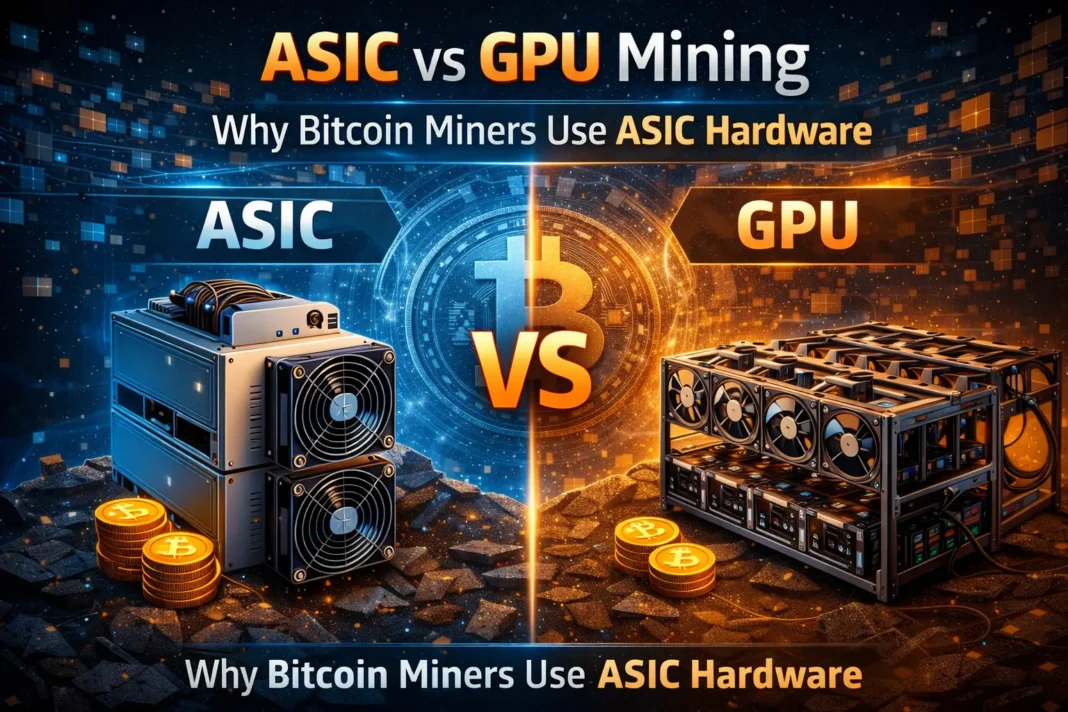
Cryptocurrency mining has evolved dramatically since the early days of Bitcoin. What once could be done on a normal computer now requires highly specialized hardware.
Today, the debate between ASIC mining vs GPU mining is central to understanding how modern Bitcoin mining works. Both technologies process cryptographic calculations used to validate transactions, but they differ greatly in efficiency, power consumption, and profitability.
To understand why ASIC hardware dominates Bitcoin mining, we need to explore how these two mining approaches compare.
What Is GPU Mining?
GPU mining uses Graphics Processing Units, the same hardware found in gaming computers and graphics workstations.
GPUs are designed to handle complex parallel computations, which makes them capable of performing cryptographic hashing operations required for mining.
In the early years of cryptocurrency, GPU mining became popular because it offered significantly more computational power than standard CPUs.
Key characteristics of GPU mining include:
- flexible hardware that can mine multiple cryptocurrencies
- moderate hashing performance
- relatively high electricity consumption
GPUs are still widely used for mining cryptocurrencies that are designed to resist ASIC hardware.
What Is ASIC Mining?
ASIC stands for Application-Specific Integrated Circuit.
Unlike GPUs, ASIC devices are built for one specific purpose: performing a single algorithm extremely efficiently.
In the case of Bitcoin mining, ASIC machines are designed specifically to compute SHA-256 hashing, the algorithm used by the Bitcoin network.
Companies such as Bitmain produce specialized mining machines capable of generating enormous hash power while optimizing energy usage.
ASIC miners are typically used in professional mining operations and large mining farms.
ASIC Mining vs GPU Mining: Key Differences
Understanding the differences between ASIC and GPU mining helps explain why ASIC hardware dominates Bitcoin mining today.
Performance
ASIC miners are vastly more powerful than GPUs when performing the SHA-256 algorithm.
A modern ASIC machine can generate hash rates that are thousands of times higher than a standard GPU setup.
This makes ASIC devices far more competitive in the Bitcoin mining ecosystem.
Energy Efficiency
Electricity is one of the largest expenses in mining.
ASIC hardware is optimized to deliver maximum hashing power while consuming less electricity per unit of computation.
GPU systems, by contrast, use significantly more energy relative to their hashing performance.
For large-scale mining operations, this difference has a major impact on profitability.
Hardware Specialization
GPUs are general-purpose devices capable of performing many types of computations, including graphics rendering and machine learning tasks.
ASIC machines are designed for only one function: mining a specific algorithm.
Because they are specialized, ASIC miners can achieve far higher efficiency than general-purpose hardware.
Flexibility
GPU mining rigs are flexible and can mine many different cryptocurrencies.
ASIC miners are limited to the algorithm they are built for.
For example, a Bitcoin ASIC miner cannot mine cryptocurrencies that use different algorithms.
This lack of flexibility is one of the few disadvantages of ASIC mining hardware.
Why ASIC Hardware Dominates Bitcoin Mining
The Bitcoin network has grown tremendously since its launch.
As more miners joined the network, competition increased, and mining difficulty rose dramatically.
Because ASIC machines offer superior hash rates and energy efficiency, they quickly replaced GPUs in the Bitcoin mining ecosystem.
Today, nearly all Bitcoin mining is performed using ASIC hardware.
This specialization has allowed the network to achieve extremely high levels of computational security.
The combined hash rate of the network represents an enormous amount of computing power distributed across the globe.
Industrial Bitcoin Mining Operations
Modern mining is often conducted in large-scale facilities known as mining farms.
These facilities operate thousands of ASIC machines running continuously to maximize hash power.
Large mining pools coordinate significant portions of the network’s computational power.
One example is Foundry USA, which contributes a large share of global hash rate.
These industrial operations are typically located in regions with access to low-cost electricity.
Are GPUs Still Used in Crypto Mining?
While GPUs are no longer competitive for Bitcoin mining, they still play an important role in the broader cryptocurrency ecosystem.
Many blockchain networks are designed to remain resistant to ASIC hardware and therefore rely on GPU mining.
In these cases, GPUs remain an important part of decentralized mining infrastructure.
However, when it comes to Bitcoin, ASIC miners dominate due to their unmatched efficiency and performance.
Final Thoughts
The comparison between ASIC mining vs GPU mining highlights how technological specialization has shaped the evolution of Bitcoin mining.
GPU mining once played a crucial role in the early growth of cryptocurrency networks, but the rise of ASIC hardware fundamentally changed the landscape.
Today, ASIC miners provide the computational power necessary to secure the Bitcoin network and maintain its decentralized architecture.
As mining technology continues to evolve, efficiency and scalability will remain key factors in the future of cryptocurrency mining.
Read more :
Complete Guide to Bitcoin Mining in 2026
