
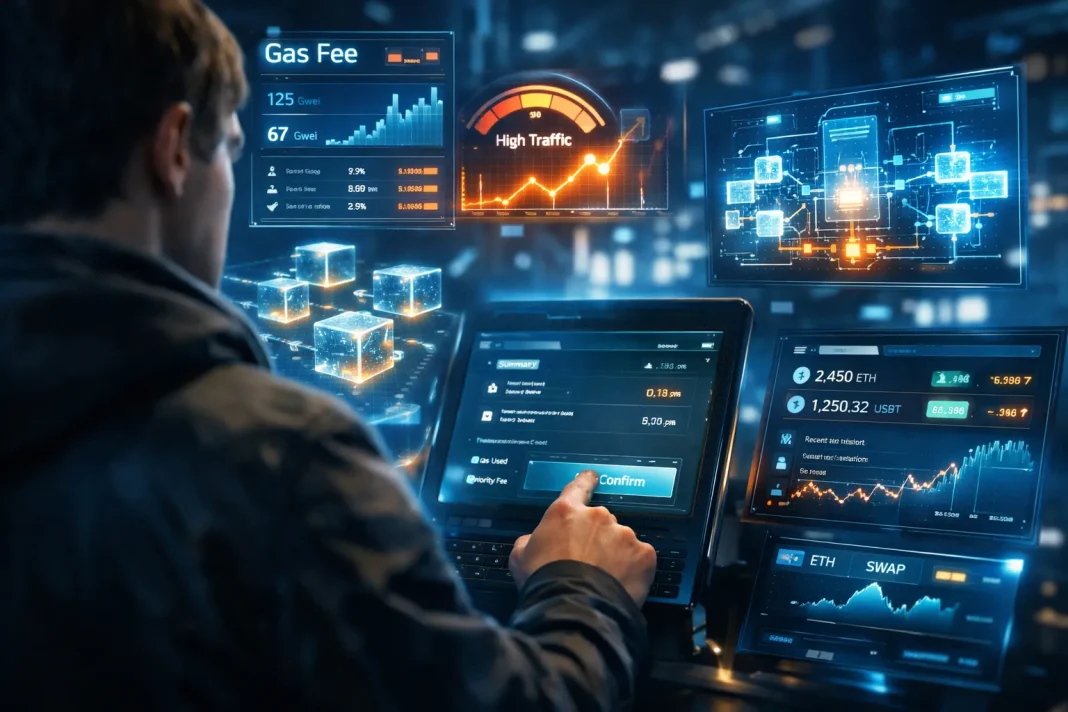
Why gas fees exist and what they mean for users is one of the most important beginner topics in Web3 because fees shape how people actually experience blockchain networks. A lot of new users think gas fees are random or unfair, but they are really part of how blockchains stay functional, resist spam, and manage limited network space.
If you want to understand why gas fees exist and what they mean for users, the easiest place to start is this: blockchains are shared digital systems, and every transaction uses resources. Sending tokens, approving a contract, swapping on a DEX, or interacting with a protocol all require the network to process and record an action. That is why fees exist.
Once you understand why gas fees exist and what they mean for users, blockchain activity starts to make much more sense. The fee is not just an extra charge. It is part of the cost of using onchain infrastructure.
If you already read Web3 Transactions Explained: The Complete Guide to Blockchain Payments, this article is the next layer. Transactions explain movement. This post explains the cost and pressure behind that movement.
Why Gas Fees Exist and What They Mean for Users in Simple Terms
To explain why gas fees exist and what they mean for users in simple terms, think of a blockchain like a network with limited room. Not every transaction can be processed instantly, and not every action costs the same amount of work.
Gas fees are the pricing system that helps the blockchain decide how resources are used.
Without fees, networks would be easier to spam, harder to prioritize, and less reliable during heavy traffic. That is one of the biggest reasons why gas fees exist and what they mean for users matters so much. Fees are not just there to annoy people. They are part of what keeps blockchain systems usable at all.
Why Gas Fees Exist and What They Mean for Users During Network Congestion
One of the biggest reasons beginners get confused is that fees rise and fall.
Sometimes a transaction seems cheap. Sometimes the same kind of action suddenly costs much more. This usually happens because demand changes. When many users want to transact at the same time, they compete for limited block space, and fees rise.
That is a major part of why gas fees exist and what they mean for users in practice. Gas fees are not fixed because network demand is not fixed. They reflect pressure inside the system.
This is especially noticeable during volatile market moments, popular token launches, heavy DeFi activity, or times when a network becomes crowded. In those moments, fees become a visible sign that the blockchain is under stress.
Why Gas Fees Exist and What They Mean for Users Interacting With Smart Contracts
Another important part of why gas fees exist and what they mean for users is that not every blockchain action is equal.
A simple wallet-to-wallet transfer is usually lighter than interacting with a smart contract. That is why some users are surprised when sending one token feels cheap, but swapping, staking, lending, or using a protocol feels more expensive.
This is where Smart Contracts Explained: The Essential Web3 Technology You Need to Understand becomes a useful internal link. Smart contracts let blockchains do more than basic transfers, but that extra logic often means more computation and therefore more cost.
In other words, why gas fees exist and what they mean for users is closely tied to what the user is actually asking the blockchain to do.
Why Gas Fees Exist and What They Mean for Users Choosing Between Networks
A lot of people only think about fees when they are already annoyed by them.
But why gas fees exist and what they mean for users also matters because fees influence which networks people choose, when they transact, and whether a blockchain feels practical for smaller everyday actions.
This is where scaling becomes important. If a network is secure but too expensive for ordinary use, users will start looking for alternatives. That is one reason it helps to connect this topic with Layer-1 vs Layer-2 Blockchains Explained: What Actually Scales Web3? and Web3 Scaling Explained: How Blockchains Grow Without Breaking Decentralization.
Those posts help explain the bigger structural side of why gas fees exist and what they mean for users. Fees are not only about cost. They are also about blockchain design choices.
Why Gas Fees Exist and What They Mean for Users in Everyday Web3 Activity
For users, the effect of gas fees is practical.
Gas fees shape whether a transaction feels worth doing. They affect the timing of swaps, transfers, and DeFi actions. They influence whether users stay on one chain, move to another, or wait for better conditions.
That is why why gas fees exist and what they mean for users is not just a technical explanation for developers. It is directly connected to user experience.
A blockchain can sound powerful in theory, but if fees make every small action feel painful, adoption becomes harder. That is one reason gas fees matter so much in real-world Web3 use.
Why Gas Fees Exist and What They Mean for Users Beyond Just Cost
Many people think the only lesson is that lower fees are better.
Lower fees do matter, but that is not the full story.
The bigger lesson behind why gas fees exist and what they mean for users is that every blockchain makes trade-offs. Some optimize for security and decentralization. Some focus more on throughput and lower-cost execution. Some try to balance both through scaling layers.
That means gas fees are not only a price tag. They are also a signal about how the system works.
They show when demand is rising. They show when block space is limited. They show that blockchain infrastructure is not free, even when the user wishes it felt more invisible.
What Beginners Should Do After Learning Why Gas Fees Exist and What They Mean for Users
Once someone understands why gas fees exist and what they mean for users, they can make much better decisions.
They can check fees before confirming transactions.
They can avoid rushing into expensive moments.
They can test new actions with smaller amounts first.
They can choose better networks for different use cases.
And they can stop treating every fee as a mystery.
This is where useful outside references can also help, such as the Ethereum gas guide, the technical Ethereum gas overview, and the MetaMask gas fee guide. These external resources explain how gas works from both the protocol and wallet side.
Final Thoughts on Why Gas Fees Exist and What They Mean for Users
In the end, why gas fees exist and what they mean for users comes down to one core idea: blockchain space is limited, network activity has a cost, and decentralized systems need a way to price access.
That is why gas fees exist.
They help prevent abuse, manage demand, and support network operation.
And what they mean for users is just as important: fees shape the real experience of using Web3. They influence convenience, timing, network choice, and whether a blockchain feels practical for normal activity.
Once you understand why gas fees exist and what they mean for users, the fee stops looking like random friction and starts looking more like what it really is — the cost of using a shared digital system.
❓ FAQ
What are gas fees in crypto?
Gas fees are transaction costs paid by users to process actions on a blockchain network. These actions can include sending tokens, swapping assets, or interacting with smart contracts.
Why do gas fees exist?
Gas fees exist because blockchains use network resources and have limited space in each block. Fees help prevent spam, prioritize transactions, and support the validators or participants who keep the network running.
Why are gas fees sometimes high?
Gas fees are often high when a blockchain is busy and many users are competing for limited block space. More demand usually means higher fees.
Do gas fees depend on how much money I send?
Not usually. Gas fees are more closely related to the complexity of the transaction and the level of network congestion than the amount of money being moved.
Why do smart contract interactions cost more?
Smart contract actions often require more computation than simple wallet-to-wallet transfers. Because they use more blockchain resources, they usually cost more in gas fees.
Can I avoid gas fees completely?
No. If you use a blockchain directly, some form of network fee usually applies. However, users can often reduce costs by choosing less congested times or using lower-cost networks and scaling solutions.
What do gas fees mean for normal users?
Gas fees affect how practical blockchain activity feels. They influence when people transact, which networks they choose, and whether small onchain actions are worth doing at all.
Are gas fees the same on every blockchain?
No. Different blockchains have different fee models, throughput levels, and design trade-offs, so gas fees can vary a lot from one network to another.
Why do gas fees matter for Web3 adoption?
Gas fees matter because they shape user experience. If fees are too high or too unpredictable, normal users may avoid using blockchain-based apps and services.
How can beginners deal with gas fees better?
Beginners can handle gas fees better by checking the fee before confirming, avoiding rushed transactions, testing new actions with small amounts, and learning how network congestion affects cost.
