

What is yield farming and why do so many crypto users talk about it like an easy way to earn passive income?
In simple terms, yield farming is a DeFi strategy where users deposit crypto into protocols, liquidity pools, or lending systems to earn rewards. Those rewards can come from trading fees, interest, governance tokens, or temporary incentive programs. At first glance, it sounds like a smart way to make idle crypto productive. But the real story is more complicated.
That is why understanding what is yield farming matters before putting money into any DeFi platform. The returns can look attractive, but the risks are often hidden behind big APY numbers and smooth user interfaces. As Chainalysis explains in its DeFi yield farming overview, strategies like providing liquidity or lending assets can generate rewards, but they also expose users to smart contract vulnerabilities, impermanent loss, and market volatility.
For beginners, this topic is important because yield farming sits at the center of DeFi activity. It connects liquidity, incentives, smart contracts, and token economics in one place. If you already read our guide to stablecoins for remittances, our breakdown of common crypto scams beginners must avoid, and our article on why institutions are interested in tokenized finance, this post continues that practical Web3 education path.
What Is Yield Farming in Crypto?
What is yield farming in crypto?
It is the process of depositing digital assets into a decentralized finance protocol so those assets can be used by the system while you earn rewards in return. Depending on the platform, that may mean lending tokens, providing liquidity to a decentralized exchange, or joining a reward program that distributes extra tokens.
The basic idea is simple: your crypto helps power a DeFi system, and the protocol rewards you for providing capital. But even though the idea sounds simple, the actual mechanics can become complex very quickly.
This is one reason why Coinbase Institutional’s DeFi explainer treats yield farming as part of a broader DeFi environment that includes lending, decentralized exchanges, and other onchain financial tools.
How Yield Farming Works
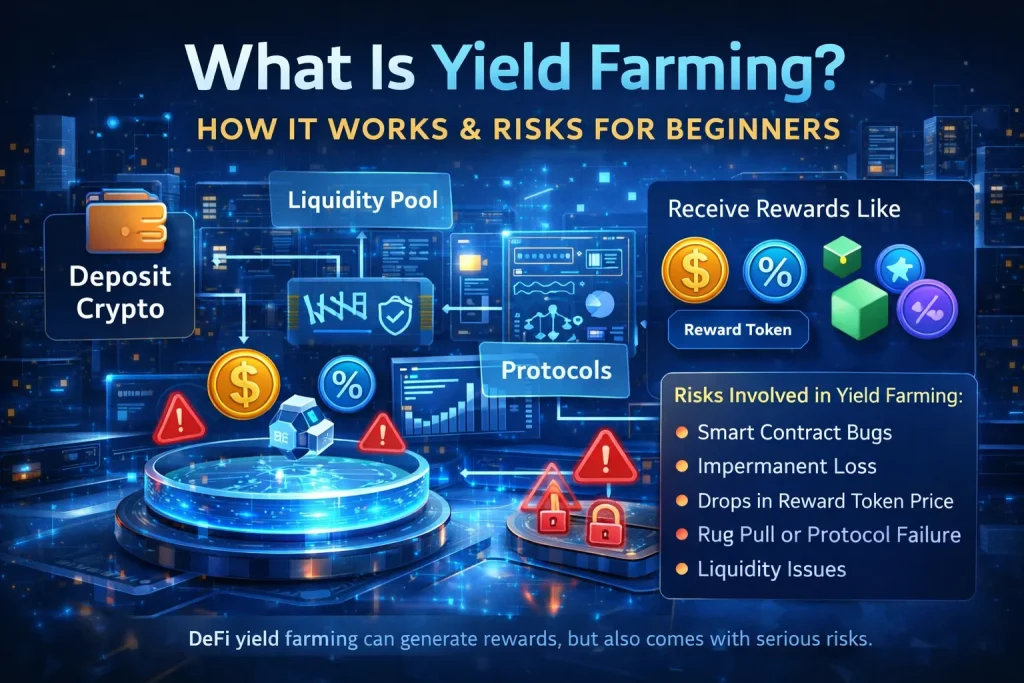
To understand what is yield farming, it helps to look at the typical process.
A user connects a wallet to a DeFi application and deposits assets into a pool or protocol. Those assets are then used in different ways depending on the platform. In lending protocols, deposited tokens can be borrowed by others. In decentralized exchanges, liquidity providers supply token pairs that help traders swap assets. In return, users may earn part of the fees, token rewards, or both.
This is where the appeal begins. Instead of simply holding crypto and hoping its price rises, users can earn extra returns from the DeFi activity happening around those assets.
But this is also where the risk begins.
A protocol may show a high APY, yet that number may depend on volatile reward tokens, short-term incentives, changing liquidity conditions, or unsustainable token emissions. In other words, the headline return often tells only part of the story.
Why Yield Farming Became So Popular
Yield farming became popular because it promised something many crypto users wanted: a way to earn returns without selling assets.
It turned passive holding into active participation. That made DeFi feel more dynamic than traditional finance for many early users. Stablecoins also played a major role in this growth because they gave users a way to participate in DeFi with less direct exposure to price swings than more volatile tokens. As Chainalysis noted in its research on stablecoins, stablecoins have become deeply embedded across DeFi activity, including lending and yield-generating strategies.
Still, popularity should never be confused with safety. Some of the biggest DeFi losses happened when users chased returns without fully understanding the structure underneath them.
1. Smart Contract Risk Is Always Present
One of the most important answers to what is yield farming and why is it risky is smart contract risk.
Yield farming depends on code. If the protocol’s smart contracts contain bugs, design flaws, or exploitable weaknesses, funds can be lost. Even when a project looks polished, the risk does not disappear. Audits help, but they do not make a protocol risk-free.
This matters because users are not trusting a traditional bank or broker. They are trusting software that may fail under pressure or be exploited by attackers. As Chainalysis explains, smart contract vulnerabilities are one of the core risks tied to DeFi yield farming.
2. Impermanent Loss Can Quietly Damage Returns
Impermanent loss is one of the most misunderstood DeFi risks.
If you provide liquidity in a pool with two assets, and the relative price between those assets changes, the value of your position may end up lower than if you had simply held those assets separately. That difference is called impermanent loss.
This is why some yield farming strategies look profitable on the surface while producing weaker real returns than expected. A user may earn fees and reward tokens, yet still underperform because the asset mix changed against them. Again, Chainalysis specifically identifies impermanent loss as a major risk in yield farming strategies.
3. Reward Tokens Can Collapse in Price
Another major part of understanding what is yield farming is understanding what kind of asset pays the reward.
Some platforms advertise very high returns, but those rewards may be paid in small-cap or weakly supported tokens. If the price of that token falls hard, the real return can collapse even if the APY looked impressive at the beginning.
This is one of the most common beginner mistakes in DeFi. People focus on the percentage number instead of asking what is actually being paid, how liquid that token is, and whether the incentive program can last.
In many cases, the highest yields exist because the risk is also high.
4. Rug Pull and Protocol Failure Risk Is Real
Not every yield farming opportunity is built on a strong foundation.
Some protocols are poorly designed. Others are rushed, unaudited, or built around weak tokenomics. In the worst cases, the team behind the project drains liquidity or abandons the platform after attracting enough deposits. Even when there is no obvious rug pull, a protocol can still fail because the entire reward structure was unsustainable from the beginning.
That is why beginners should never assume a professional-looking interface means a safe protocol. In DeFi, appearance is not proof of quality.
5. Temporary Incentives Can Make Yields Look Better Than They Are
A lot of yield farming depends on temporary incentive programs.
Protocols often launch with extra token rewards to attract capital quickly. That can create eye-catching APY numbers, but those returns often fall after the emissions slow down or user participation increases. The result is simple: the yield that pulled users in may not be the yield they keep receiving.
This is why beginners should treat very high APY figures with caution. Sometimes the return is high because it is temporary, not because the underlying protocol is exceptionally strong.
6. Liquidity and Exit Risk Matter More Than Beginners Expect
Some yield farming strategies are easy to enter but harder to exit efficiently.
If the pool is shallow, the token becomes less liquid, or market stress increases, users may face slippage and poor execution when trying to leave. In smaller DeFi ecosystems, this can become a serious problem fast.
That means yield farming is not just about earning rewards while things look good. It is also about understanding what happens when you want to exit under pressure.
7. Bridge and Infrastructure Risk Add Extra Layers of Danger
Modern DeFi does not operate on a single simple layer.
A yield farming strategy may depend on bridges, price oracles, wrapped assets, cross-chain messaging, and several integrated smart contracts at once. If one part of that chain fails, the whole system can face stress. As Chainalysis explains in its guide to cross-chain bridges, multi-chain systems create new opportunities but also new attack surfaces and dependencies.
This makes yield farming riskier than many users first realize. The front-end may look simple, but the underlying infrastructure can be highly complex.
8. Regulation Can Change Access and Perception
Another reason what is yield farming and why is it risky remains an important question is regulation.
Rules around DeFi access, token incentives, protocol front ends, and onchain financial products continue to evolve. Even if a protocol remains live onchain, access through websites, interfaces, or specific services may change depending on legal and compliance pressure. A recent SEC filing discussing DeFi-related risks shows how seriously regulatory and operational uncertainty is still treated.
For beginners, the main point is simple: platform access and user confidence can shift quickly in this sector.
9. Complexity Itself Is a Risk
Sometimes the biggest risk is not the protocol. It is misunderstanding the strategy.
Yield farming can involve token pairs, reward schedules, collateral rules, wallet approvals, bridge transfers, and changing liquidity conditions. A beginner may think they are earning passive income when they are actually exposed to several layers of technical, market, and operational risk at the same time.
That is why education matters so much in DeFi. Complexity can create losses even without a hack or rug pull if the user does not understand what they entered.
Is Yield Farming the Same as Staking?
Not exactly.
People often confuse staking and yield farming because both can produce returns. But they are different. Staking usually means locking tokens to support a blockchain network or validator system. Yield farming is broader and usually involves DeFi protocols, lending systems, liquidity pools, and token incentives.
Some strategies overlap, but yield farming is often more complex and carries additional risk beyond basic staking. That makes the beginner learning curve steeper.
Can Yield Farming Still Make Sense?
Yes, but only when users treat it seriously.
Yield farming can make sense for experienced users who understand DeFi mechanics, evaluate protocol quality carefully, and size positions responsibly. It may also make more sense in some stablecoin-based strategies where volatility is lower, though those strategies still carry smart contract and platform risk.
The key point is that yield farming should not be treated like a guaranteed savings account. It is closer to active risk management inside a fast-moving digital financial system.
Final Thoughts on What Is Yield Farming
So, what is yield farming?
It is a DeFi strategy where users supply crypto assets to protocols in exchange for rewards. And why is it risky? Because those rewards are connected to smart contracts, liquidity mechanics, token incentives, market volatility, infrastructure dependencies, and user decisions that can all change very quickly.
For beginners, the biggest mistake is focusing only on the yield. The smarter approach is to ask where the yield comes from, what could break, and whether the reward truly matches the risk.
In DeFi, high returns are rarely free. The more attractive the opportunity looks, the more carefully it should be examined.
❓ FAQ
What is yield farming in crypto?
Yield farming is a DeFi strategy where users deposit crypto into protocols or liquidity pools to earn rewards such as fees, interest, or incentive tokens.
Why is yield farming risky?
Yield farming is risky because users can face smart contract bugs, impermanent loss, token price crashes, liquidity problems, and unsustainable rewards.
Is yield farming the same as staking?
No. Staking usually supports a blockchain or validator system, while yield farming often involves DeFi protocols, lending, liquidity pools, and incentive programs.
Can beginners do yield farming safely?
Beginners should be cautious. It is better to understand the protocol, token risk, reward structure, and liquidity mechanics before depositing funds.
What is impermanent loss?
Impermanent loss happens when the value of assets in a liquidity pool changes relative to just holding those assets separately.
