
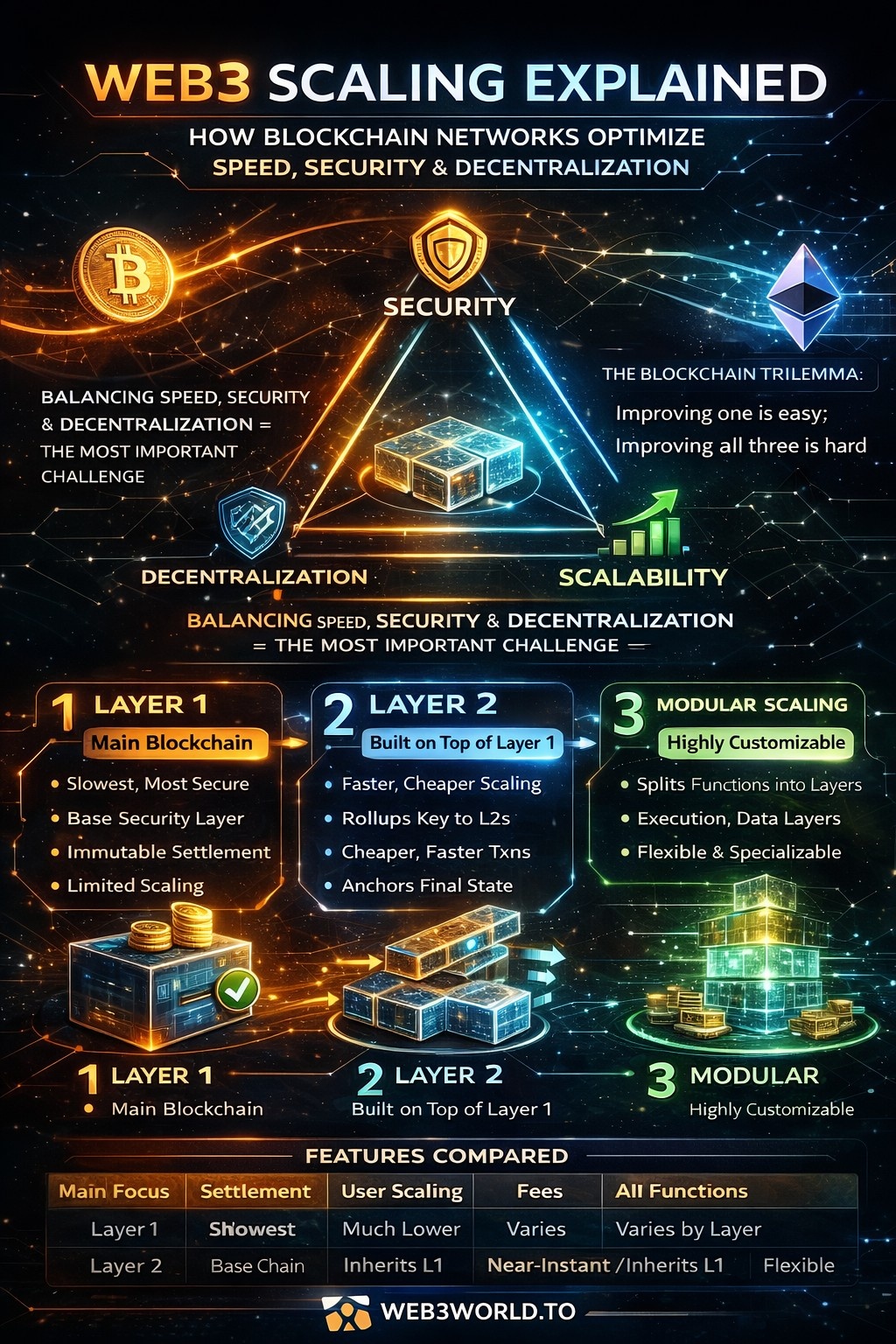
One of the biggest challenges in Web3 is simple to describe but hard to solve:
How do blockchains scale to millions of users without becoming centralized?
Web3 scaling is not about making blockchains faster at any cost. It’s about balancing speed, security, and decentralization — a problem that has shaped every major blockchain design decision.
This article explains what Web3 scaling really means, the main approaches used today, and why there is no single perfect solution.
What Does “Scaling” Mean in Web3?
In Web3, scaling means increasing:
- Transaction throughput
- Network capacity
- User adoption
Without sacrificing:
- Security
- Decentralization
- Trust minimization
This is much harder than scaling traditional Web2 systems because blockchains require global consensus.
The Blockchain Trilemma
Web3 scaling revolves around the blockchain trilemma:
You can optimize for:
- Security
- Decentralization
- Scalability
—but improving two usually weakens the third.
For example:
- Faster blocks → fewer nodes
- Larger blocks → higher hardware requirements
- Fewer validators → more centralization
This is why networks like Bitcoin intentionally remain conservative.
Why Layer-1 Scaling Is Limited
Layer-1 blockchains process transactions directly on the base chain.
Constraints include:
- Block size limits
- Block time
- Node synchronization
- Global state replication
If Layer-1 scaled aggressively:
- Running a node would be expensive
- Fewer participants could verify the chain
- Decentralization would decrease
This is why pure Layer-1 scaling has strict limits.
Main Web3 Scaling Approaches
1️⃣ Vertical Scaling (Limited Use)
Vertical scaling means:
- Bigger blocks
- Faster blocks
- More powerful nodes
Pros:
✔️ Simple
Cons:
❌ Centralization risk
❌ Higher hardware costs
Used cautiously, not aggressively.
2️⃣ Layer-2 Scaling (Most Important Today)
Layer-2 solutions process transactions off the main chain and settle results back to Layer-1.
Benefits:
- Lower fees
- Faster confirmations
- Maintains Layer-1 security
This is currently the dominant scaling strategy, especially on Ethereum.
3️⃣ Rollups (Core of Modern Scaling)
Rollups bundle thousands of transactions into a single Layer-1 submission.
Two main types:
- Optimistic rollups (assume validity)
- Zero-knowledge rollups (prove validity)
Rollups reduce:
- On-chain data
- Gas costs
- Network congestion
4️⃣ Sharding (Long-Term Scaling)
Sharding splits a blockchain into multiple parallel chains (shards).
Each shard:
- Processes part of the workload
- Shares security with the main chain
Sharding improves:
✔️ Throughput
✔️ Parallelism
But increases complexity significantly.
5️⃣ Off-Chain & Hybrid Solutions
Some data and computation move:
- Off-chain
- Into execution layers
- Into data availability layers
Only critical settlement happens on-chain.
This hybrid model is becoming standard.
Bitcoin vs Ethereum Scaling Philosophy
Bitcoin
- Base layer stays minimal
- Scaling happens above the chain
- Focus on security and settlement
Bitcoin treats scaling as a payment problem, not a computation problem.
Ethereum
- General-purpose execution
- Smart contracts
- Modular scaling approach
Ethereum treats scaling as a computation and data problem.
Both approaches are valid — for different goals.
Why Web3 Scaling Is Slow (By Design)
Web3 prioritizes:
- Verifiability
- Neutrality
- Permissionless access
Fast but centralized systems already exist in Web2.
Web3 scales carefully, because mistakes are:
- Public
- Permanent
- Expensive
Common Web3 Scaling Myths
❌ “One chain will scale everything”
✔️ Reality: Modular, layered systems scale better
❌ “Faster = better”
✔️ Reality: Security and decentralization matter more
❌ “Scaling is solved”
✔️ Reality: It’s an ongoing process
What Scaled Web3 Will Look Like
The future of Web3 scaling is:
- Layered
- Modular
- Specialized
Users won’t need to know:
- Which layer they’re on
- Where execution happens
- How settlement works
They’ll just experience cheap, fast, secure transactions.
Final Thoughts
Web3 scaling is not about speed alone — it’s about preserving trust while expanding access.
Layer-1 provides security.
Layer-2 provides usability.
Modular design provides flexibility.
Together, they form the foundation for global, decentralized infrastructure.
At Web3World.to, we explain Web3 as it really is — engineering first, hype last.
