
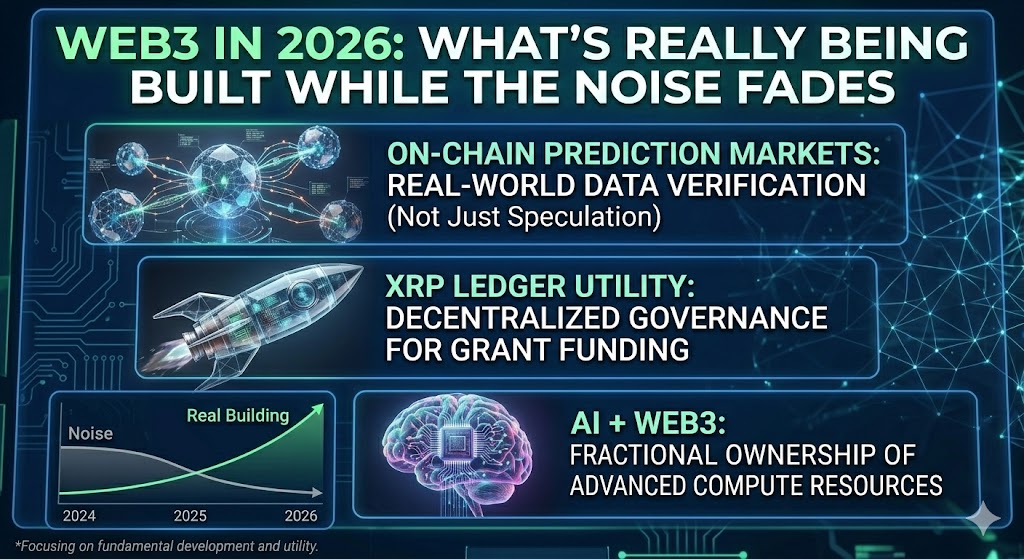
A few years ago, Web3 felt loud. Every week there was a new token, a new promise, and a new reason to believe the internet was about to change overnight.
In 2026, it feels different — quieter, slower, and far more serious.
And that’s not a bad thing.
What’s happening now is less about headlines and more about foundations. Web3 hasn’t disappeared; it has settled into the long, often invisible work of becoming infrastructure.
The End of the “Everything Is a Revolution” Phase
In its early years, Web3 tried to do everything at once. Finance, identity, governance, social media, gaming — all on-chain, all decentralized, all immediately.
Reality pushed back.
Networks struggled under load. Users were confused by wallets and fees. Too many projects promised more than they could deliver. Over time, the industry learned an uncomfortable but necessary lesson: real systems grow slowly.
By 2026, many of the flashy experiments are gone. What remains are projects focused on stability, usability, and long-term relevance.
That shift is the most important change in Web3 today.
Web3 Is Becoming Infrastructure, Not a Destination
One of the clearest signs of maturity is that Web3 is no longer asking users to “enter” it.
Instead, it’s quietly sitting underneath applications people already use.
Payments move across blockchain rails without users seeing addresses. Logins rely on cryptographic signatures instead of passwords. Digital assets exist in games and platforms where the word “blockchain” is never mentioned.
This is how real technology wins — not by being visible, but by being reliable.
The internet didn’t succeed because people loved TCP/IP. It succeeded because it worked. Web3 is following the same path.
Why Identity Might Matter More Than Tokens
When people talk about Web3, they still tend to focus on coins and prices. But some of the most meaningful work is happening in areas that rarely trend on social media — especially identity.
Decentralized identity systems are slowly changing how digital trust works. Instead of accounts owned by platforms, identity can belong to the user. Instead of sharing entire profiles, people can prove specific facts — age, credentials, ownership — without giving up everything else.
These ideas aren’t theoretical anymore. Standards developed by groups like the World Wide Web Consortium are already being used in real applications.
This kind of change doesn’t move markets overnight, but it reshapes how the internet works over decades.
Scaling Without Breaking Trust
One of Web3’s hardest problems has always been scale. Blockchains are secure, but security comes at a cost: speed.
The solution hasn’t been to make blockchains faster at any cost. Instead, the ecosystem has learned to layer systems.
Core networks focus on security and final settlement. Additional layers handle execution, batching, and user experience. Data is stored efficiently without overwhelming the base layer.
This modular approach mirrors how modern cloud systems evolved — by breaking complex systems into specialized parts.
The trade-off is complexity behind the scenes. The benefit is that users can interact with Web3 applications without thinking about gas fees, confirmations, or network congestion.
Governance: Less Idealism, More Engineering
Early Web3 governance was often presented as a perfect form of digital democracy. In practice, it turned out to be much messier.
By 2026, governance is treated more like engineering than ideology.
Developers now recognize that:
- Most users don’t want to vote on everything
- Participation naturally concentrates
- Incentives shape behavior more than ideals
Modern governance systems focus on minimizing damage, enabling upgrades, and preventing capture — not on creating utopian voting systems.
This realism has made many protocols more resilient, even if they are less romantic.
Adoption Isn’t About Numbers on a Chart
Price still dominates attention, but it’s one of the least reliable indicators of real progress.
A healthier way to judge Web3 today is by asking quieter questions:
- Are people using applications repeatedly?
- Are developers still building during slow markets?
- Are systems stable under stress?
In many cases, the answers are yes.
Usage grows unevenly and often invisibly, but it grows. That’s usually how long-term technology adoption looks in real life.
Regulation Is No Longer the Villain
For a long time, regulation was treated as the enemy of Web3. That mindset has largely faded.
Clear rules make it easier for serious companies to build, for institutions to participate, and for users to trust what they’re using. In 2026, many Web3 systems are designed with compliance in mind — without giving up decentralization where it actually matters.
This balance isn’t perfect, but it’s improving.
And improvement, not purity, is what keeps systems alive.
The Quiet Truth About Web3 in 2026
Web3 isn’t trying to replace the internet anymore. It’s trying to fix specific weaknesses:
- Fragile trust models
- Centralized control of identity
- Inefficient value transfer
- Lack of user ownership
It’s doing that slowly, sometimes imperfectly, and often without attention.
That’s usually how real progress happens.
Final Thought
If you’re looking for excitement, Web3 in 2026 may feel boring.
If you’re looking for durability, it’s more interesting than ever.
The noise has faded. The builders stayed. And the work being done now is the kind that only becomes obvious once it’s everywhere.
