
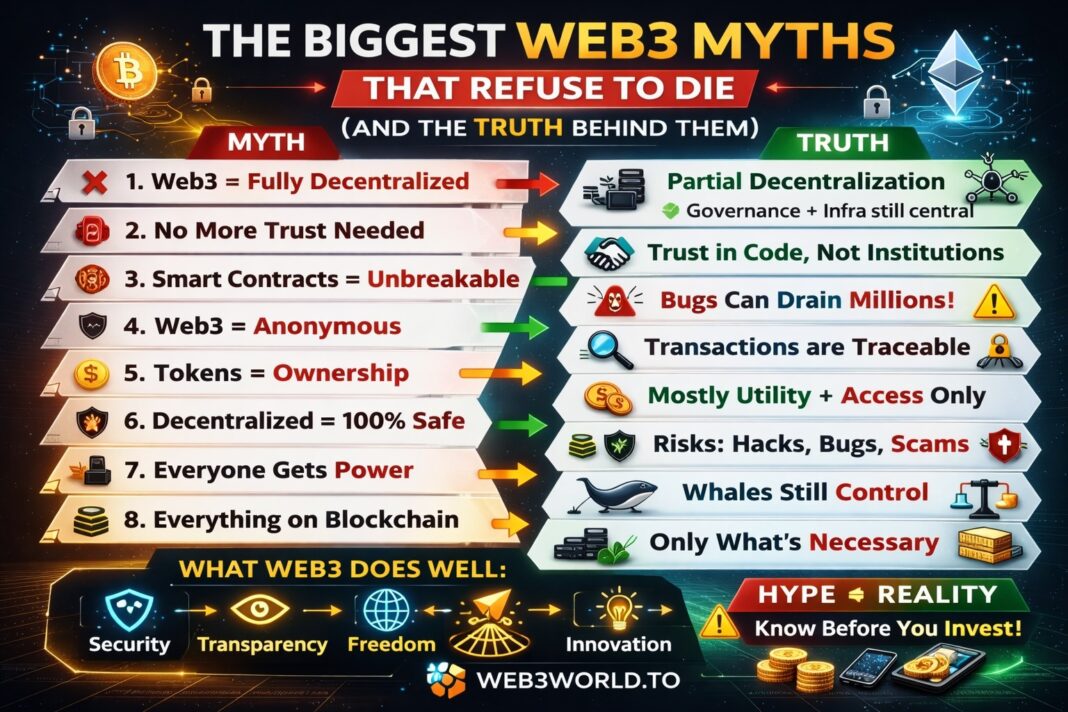
Web3 is often presented as a revolution that will replace banks, governments, and even the internet itself. While the technology is powerful, many popular beliefs about Web3 are simply not true.
These myths create unrealistic expectations, bad decisions, and unnecessary disappointment.
Let’s break down the biggest Web3 myths — and explain what’s actually real.
Myth #1: Web3 Is Fully Decentralized
Reality: Most Web3 projects are only partially decentralized.
In practice:
- Frontends are hosted on centralized servers
- Admin keys still exist
- Governance power is often concentrated
True decentralization is rare and difficult. Even major networks like Ethereum are still evolving toward stronger decentralization.
Decentralization is a spectrum, not a checkbox.
Myth #2: Web3 Eliminates the Need for Trust
Reality: Web3 reduces some trust — it doesn’t eliminate it.
You still trust:
- Smart contract code
- Developers
- Oracles
- Wallet software
- Bridges
Web3 shifts trust from institutions to technology and incentives, which can be safer — but not trust-free.
Myth #3: Smart Contracts Are Unbreakable
Reality: Smart contracts are software — and software can have bugs.
History shows:
- Logic errors
- Exploits
- Flash loan attacks
- Upgrade mistakes
Once deployed, smart contract bugs can be permanent and expensive.
Code audits reduce risk — they don’t eliminate it.
Myth #4: Web3 Is Anonymous
Reality: Most blockchains are public and traceable.
- Wallet addresses are pseudonymous
- Transactions are permanently visible
- Activity can often be linked over time
Compared to cash, Web3 is more transparent, not more private.
Privacy requires additional tools — it is not default.
Myth #5: Tokens Always Represent Ownership
Reality: Most tokens provide no legal ownership rights.
In many cases, tokens:
- Are governance signals
- Grant utility access
- Represent incentives
They usually do not represent equity, dividends, or legal claims.
Confusing tokens with shares is one of the most dangerous Web3 misconceptions.
Myth #6: Decentralized = Safe
Reality: Decentralization does not guarantee safety.
Risks still include:
- Bad code
- Poor economic design
- Governance attacks
- Bridge vulnerabilities
In fact, decentralized systems often have fewer recovery options when something goes wrong.
Myth #7: Web3 Automatically Empowers Users
Reality: Power often concentrates again — just in new forms.
Examples:
- Whale-dominated DAOs
- VC-heavy token allocations
- Validator concentration
- Frontend control
Without careful design, Web3 can recreate old power structures on new rails.
Myth #8: Everything Should Be on the Blockchain
Reality: Blockchains are expensive and slow by design.
Putting everything on-chain leads to:
- High fees
- Poor performance
- Unnecessary complexity
Good Web3 architecture uses:
- On-chain for trust & settlement
- Off-chain for speed & storage
Not everything benefits from decentralization.
Myth #9: Web3 Will Replace Web2 Completely
Reality: Web3 will augment, not replace, Web2.
Most real-world systems will be:
- Hybrid
- Layered
- Gradual
Even today, Web3 relies heavily on Web2 infrastructure like hosting, APIs, and browsers.
Myth #10: Early Adoption Guarantees Profit
Reality: Early adoption increases risk, not certainty.
For every successful early project:
- Many fail
- Many stagnate
- Many disappear quietly
Web3 rewards understanding, not just timing.
Why These Myths Persist
- Marketing exaggeration
- Influencer incentives
- Bull market psychology
- Complexity masking reality
Education usually lags behind innovation.
What Web3 Actually Does Well
When used correctly, Web3 excels at:
- Censorship resistance
- Transparent settlement
- Permissionless access
- Programmable value
- Global coordination
But only when expectations are realistic.
Final Thoughts
Web3 is powerful — but it’s not magic.
Believing myths leads to:
- Bad investments
- Weak systems
- Disillusionment
Understanding reality leads to:
- Better design
- Smarter usage
- Sustainable growth
At Web3World.to, we focus on clarity over hype — because real adoption depends on truth, not promises.
