
Introduction
The global financial system is undergoing a transformation as blockchain technology introduces new ways to move money across borders. One of the most significant developments in this transition is the rise of stablecoins, digital assets designed to maintain a stable value by being pegged to traditional currencies such as the US dollar. This evolution raises the question of how stablecoins vs swift payments will play a role in the future of international transactions.
In recent years, stablecoins have evolved from niche cryptocurrency tools into a powerful infrastructure layer for global payments. Many industry analysts now believe that stablecoins could eventually challenge or even replace parts of the SWIFT international payment network, which has been the backbone of cross-border banking transactions for decades. This presents a compelling scenario in the context of stablecoins vs swift payments.
The question is no longer whether blockchain will influence global finance — but how quickly stablecoin-based payment systems could reshape international banking.
Understanding the dynamics between stablecoins vs swift payments is essential for grasping the future of financial transactions.
What Is the SWIFT Payment Network?
The SWIFT network (Society for Worldwide Interbank Financial Telecommunication) is a global messaging system used by banks to send payment instructions to each other. It connects more than 11,000 financial institutions across over 200 countries.
While SWIFT is widely used and trusted, it has several limitations:
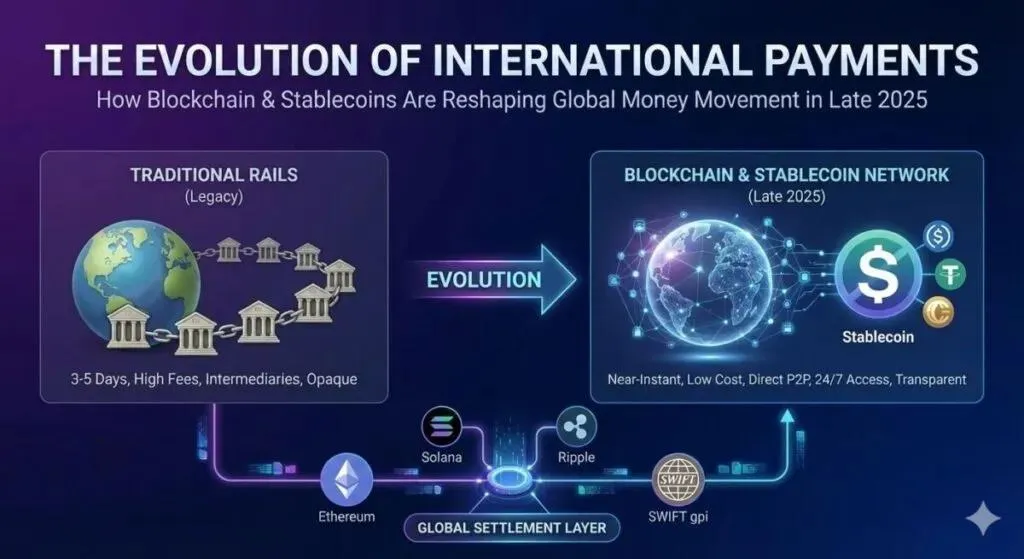
- International transfers can take 1–5 business days
- Transactions often involve multiple intermediary banks
- Fees can be expensive for cross-border transfers
- Banking hours limit transaction availability
Because SWIFT primarily sends payment instructions rather than money itself, transfers often require multiple settlement steps across different banking systems.
This complex infrastructure has made SWIFT reliable but relatively slow compared to modern digital payment technologies.
External source explaining SWIFT infrastructure:
https://www.swift.com
How Stablecoins Work
Stablecoins are cryptocurrencies designed to maintain a stable price by being backed by real-world assets such as fiat currency or short-term government bonds.
The most widely used stablecoins include:
- USDT (Tether)
- USDC (USD Coin)
- DAI
Unlike traditional cryptocurrencies such as Bitcoin, stablecoins aim to minimize volatility while still benefiting from blockchain technology.
Key advantages include:
- Instant blockchain settlement
- 24/7 global transfers
- Lower transaction fees
- Programmable financial infrastructure
Stablecoins operate on decentralized networks such as Ethereum, Tron, and Solana, allowing users to send funds globally without relying on traditional banking intermediaries.
For readers who want to understand the blockchain infrastructure securing crypto networks, read our guide on how Bitcoin mining works:
https://web3world.to/how-bitcoin-mining-actually-works-hashes-blocks-and-rewards/
Why Stablecoins Could Challenge SWIFT
The biggest advantage stablecoins have over traditional payment systems is speed and efficiency.
Blockchain transactions settle within seconds or minutes rather than days.
For example, sending a stablecoin payment from Asia to Europe can take less than one minute, while the same transaction using traditional banking rails may take several days.
Stablecoins also operate on open blockchain networks, meaning transactions can occur at any time without banking hours or geographic restrictions.
Key reasons stablecoins are gaining adoption in global payments include:
1 Faster settlement
Blockchain transactions can confirm within seconds, dramatically reducing settlement delays.
2 Lower costs
International wire transfers can cost $20–$50 or more, while many stablecoin transfers cost less than $1.
3 Financial accessibility
Stablecoins allow users to send money globally using only a digital wallet and internet connection.
4 Programmable finance
Smart contracts enable automated payments, escrow services, and decentralized financial applications.
These advantages are why many fintech companies are experimenting with stablecoin-based payment infrastructure.
External analysis on stablecoins and payments:
https://www.coindesk.com
Major Financial Institutions Are Paying Attention
Stablecoins are no longer just a crypto-native innovation. Major financial institutions are increasingly exploring how blockchain-based payment systems could complement or replace traditional banking rails.
Several global payment providers are investing heavily in blockchain infrastructure and stablecoin technology.
Some fintech platforms now offer payment networks where businesses can settle international invoices using stablecoins instead of bank transfers.
These systems could dramatically improve global trade efficiency by reducing settlement times and transaction costs.
Institutional interest in blockchain infrastructure also reflects a broader shift toward tokenized financial systems, where traditional assets and payments move onto decentralized networks.
If you want to understand the broader infrastructure behind decentralized financial systems, read our article on Web3 node infrastructure:
The Hidden Infrastructure of Web3: Why Nodes Are the Real Backbone of Blockchain
Stablecoins and the Rise of Tokenized Finance
Stablecoins are also playing a crucial role in the development of tokenized assets and decentralized finance (DeFi).
In decentralized finance ecosystems, stablecoins often function as the base currency used for lending, trading, and liquidity pools.
DeFi protocols rely heavily on stablecoins because they offer the stability needed for financial operations while still benefiting from blockchain transparency and automation.
Tokenized assets — such as real estate, commodities, and securities — are also often traded using stablecoins as settlement currency.
Explore the potential of tokenized financial systems in our article:
https://web3world.to/tokenized-assets-market-could-reach-trillions-by-2030/
Challenges Stablecoins Must Overcome
Despite their advantages, stablecoins still face several obstacles before they could fully replace traditional payment networks.
Regulatory uncertainty
Governments around the world are developing regulatory frameworks for stablecoins and digital asset payments.
Financial stability concerns
Some regulators worry that large-scale stablecoin adoption could impact traditional banking liquidity.
Infrastructure integration
Global banks and financial institutions would need to integrate blockchain infrastructure with existing financial systems.
Security risks
Smart contract vulnerabilities and cyber threats remain important considerations for blockchain payment networks.
These challenges mean that stablecoins are unlikely to completely replace SWIFT overnight. Instead, a hybrid financial system combining blockchain and traditional banking infrastructure may emerge.
For a deeper understanding of blockchain security and mining infrastructure, see our comparison of ASIC vs GPU mining hardware:
https://web3world.to/asic-vs-gpu-mining-why-bitcoin-miners-use-asic-hardware/
Could Stablecoins Become the Future of Global Payments?
While stablecoins may not fully replace SWIFT immediately, they are increasingly viewed as a powerful alternative for certain types of transactions.
Experts believe stablecoins could dominate several areas of global finance, including:
- International remittances
- cross-border business payments
- digital commerce settlements
- decentralized financial applications
In many ways, stablecoins represent the next step in the evolution of digital payments.
Just as the internet transformed communication, blockchain technology may transform the movement of money across the global economy.
Readers interested in the broader economics of blockchain systems can explore our Complete Guide to Bitcoin Mining in 2026:
https://web3world.to/complete-guide-to-bitcoin-mining-in-2026/
Conclusion
Stablecoins are rapidly emerging as a powerful financial technology capable of transforming how money moves across borders.
By combining the stability of traditional currencies with the efficiency of blockchain networks, stablecoins offer a faster, cheaper, and more accessible alternative to legacy payment systems.
While SWIFT will likely remain a critical part of the global financial infrastructure for years to come, stablecoin-based payment networks are already proving that blockchain technology can significantly improve international transactions.
As adoption continues to grow, stablecoins may become one of the most important building blocks of the next generation of global financial infrastructure.
FAQ
1. What are stablecoins in cryptocurrency?
Stablecoins are digital assets designed to maintain a stable value by being pegged to traditional currencies such as the US dollar or euro. They combine the stability of fiat money with the speed and transparency of blockchain technology, making them useful for payments and decentralized finance.
2. How do stablecoins enable global payments?
Stablecoins enable global payments by allowing users to transfer digital dollars across blockchain networks instantly. Unlike traditional banking transfers that can take several days, stablecoin transactions often settle within seconds or minutes.
3. Could stablecoins replace the SWIFT payment system?
Stablecoins could potentially replace some functions of the SWIFT payment network because they allow faster and cheaper international transfers. However, most experts believe stablecoins will initially complement traditional banking systems rather than fully replace them.
4. Why are stablecoins faster than bank transfers?
Stablecoin transactions run on blockchain networks that operate 24/7. This allows payments to settle instantly without waiting for bank processing times, intermediary banks, or international clearing systems.
5. What are the most popular stablecoins?
The most widely used stablecoins include:
- USDT (Tether)
- USDC (USD Coin)
- DAI
These stablecoins are commonly used for trading, payments, and decentralized finance applications.
6. Are stablecoin payments safe?
Stablecoin payments are generally secure because they use blockchain technology and cryptographic verification. However, risks can still exist depending on the stablecoin issuer, smart contract security, and regulatory oversight.
7. Why are banks and institutions interested in stablecoins?
Financial institutions are exploring stablecoins because they can significantly reduce the cost and time required for international payments. Stablecoins also allow programmable transactions using smart contracts, enabling new financial services.
8. What is the future of stablecoins in global finance?
Stablecoins are expected to play a major role in the future financial system by supporting cross-border payments, decentralized finance, tokenized assets, and digital commerce. Many analysts believe they could become a core component of the next generation of global payment infrastructure.
