

Stablecoins for remittances are becoming one of the strongest real-world use cases in crypto. For years, sending money across borders has been expensive, slow, and dependent on multiple intermediaries. Traditional remittance systems still serve millions of families, but high fees, delays, and exchange-rate friction continue to make them inefficient for many users. That is why more people are asking whether stablecoins can become a better option for global money transfers.
The case for stablecoins for remittances is growing because they allow users to move digital dollars across blockchain networks at any time, often faster than traditional systems. Instead of waiting for several institutions to process a transfer, users can send value directly through internet-based financial rails. This matters even more when the cost of remittances remains high. According to the World Bank Remittance Prices Worldwide, the average global cost of sending remittances is still far above the long-discussed affordability target. That alone explains why new payment models continue to gain attention.
For Web3 readers, remittances are not just another crypto narrative. They are a real economic need that affects millions of households. If digital payment rails can reduce cost and increase speed, then stablecoins for remittances could become one of the most practical forms of blockchain adoption. If you want a broader look at how digital assets are moving into traditional finance, you can also read why institutions are interested in tokenized finance and how crypto ETFs help traditional investors enter the market.
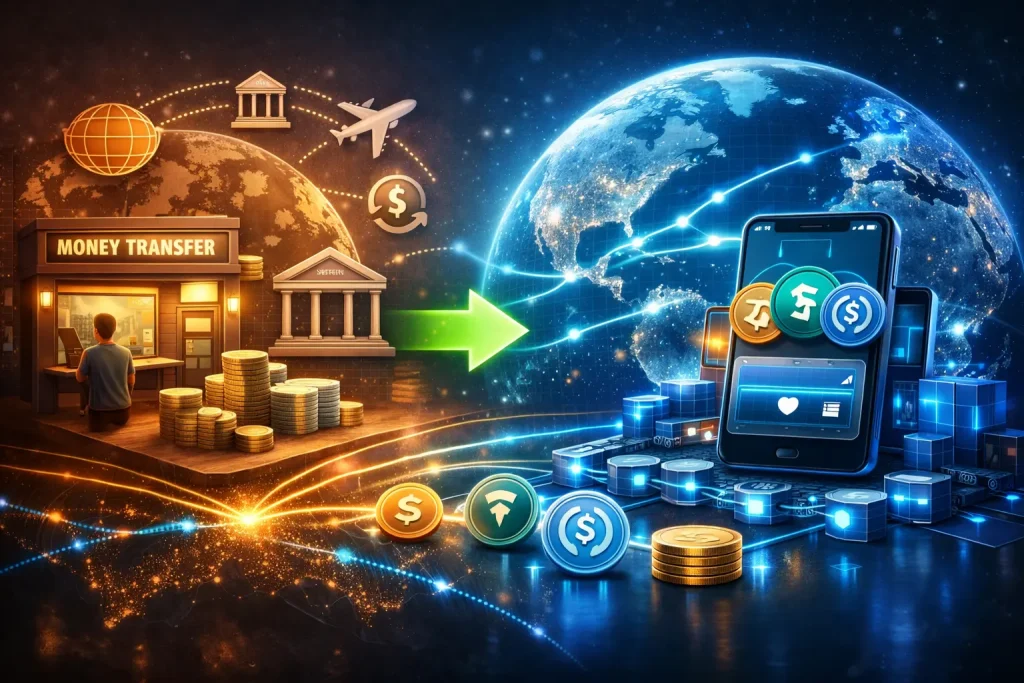
Why Traditional Remittance Systems Still Matter
Traditional remittance systems became dominant for a reason. They are familiar, regulated, and available in many countries. A worker can send money through a known provider, and the recipient can often receive it through cash pickup or bank deposit. For many families, that familiarity creates trust.
But the older model also creates friction. Transfers often pass through several institutions before reaching the final recipient. Each layer may add cost, time, or foreign exchange spread. In many corridors, users still pay more than they should for small transfers. That is one reason policymakers continue to focus on improving cross-border payments. The Financial Stability Board has repeatedly highlighted the need for faster, cheaper, and more transparent global payment systems.
This is exactly where stablecoins for remittances begin to stand out.
How Stablecoins for Remittances Work
Stablecoins are digital assets designed to maintain a stable value, most often by being pegged to the US dollar. Instead of sending a volatile crypto asset, users can send a token that aims to hold steady purchasing power during the transfer process.
That makes stablecoins for remittances much more suitable for real payments than many speculative crypto assets. A sender does not want a transfer to lose value before the recipient receives it. Stablecoins reduce that problem while also allowing settlement on blockchain networks that operate 24/7.
This is why stablecoins are increasingly discussed as payment infrastructure rather than just trading tools. Circle has written in detail about how stablecoin-based payments are becoming more important in global commerce, especially for faster settlement and programmable value transfer through blockchain rails. You can see that in their analysis of stablecoin payments and digital commerce.
Lower Fees Could Be the Biggest Advantage
The biggest reason people are interested in stablecoins for remittances is simple: lower costs.
When someone sends a few hundred dollars every month, even a small fee difference matters over time. Traditional remittance services may charge transfer fees, hidden exchange-rate spreads, or other processing costs. Those costs reduce the actual amount that reaches the family receiving the money.
Stablecoin transfers can reduce part of that burden by moving value on blockchain infrastructure instead of through a long chain of financial intermediaries. That does not always mean zero cost, because users still need on-ramps and off-ramps, but it can still make the process cheaper than older systems in the right conditions.
This is one reason the remittance use case feels more serious than many crypto narratives. It solves a real problem, and it does so in a way ordinary users can understand: lower fees and faster transfers.
Speed Matters in Real Life
Another reason stablecoins for remittances are attracting attention is speed. Many traditional transfers are not truly instant, especially when weekends, banking hours, and cross-border settlement rules are involved.
Blockchain networks do not stop operating at the end of the business day. That means stablecoin transfers can often move much faster, especially when both users are already connected to digital wallets or payment apps. For families waiting on money for food, rent, medicine, or school fees, faster settlement is not a luxury. It can be critical.
This is also why stablecoins are often discussed together with broader payment modernization. They match the internet-era expectation that value should move as quickly as information.
Stablecoins Can Also Expand Access to Digital Dollars
In some countries, the attraction of stablecoins for remittances is not only speed or cost. It is also access to a relatively stable unit of value.
A recipient may prefer receiving a dollar-backed stablecoin instead of immediately receiving funds in a weaker local currency. In that situation, stablecoins are not just a transfer rail. They also become a store of value, at least over shorter time periods.
That does not mean there are no risks. The Financial Stability Board’s work on stablecoins in emerging markets makes clear that foreign-currency stablecoins can raise important policy and financial stability concerns. But it also shows why these assets continue to attract attention in places where users want more reliable dollar access.
The Real Challenge Is Not Sending. It Is Receiving and Using the Funds
This is where many discussions become too idealistic.
Sending stablecoins is only one part of the process. The recipient still needs to use the money in everyday life. If they cannot easily convert stablecoins into local currency, spend them through merchants, or store them safely, then the overall system still has friction.
That means stablecoins for remittances only work well when the full flow is strong. Users need easy wallets, trusted exchanges, local payment access, and a clear way to cash out or spend. If those pieces are weak, then traditional remittance providers may still offer the simpler experience.
So the real competition is not only about transfer technology. It is about which system delivers the best full user experience from start to finish.
Regulation Will Shape the Future
Regulation is one of the biggest factors that will determine whether stablecoins for remittances scale globally.
Without trust, transparency, reserve quality, and compliance standards, many institutions and payment companies will hesitate to rely on stablecoin infrastructure. At the same time, stronger regulation could help stablecoins grow because it would reduce uncertainty and make the ecosystem more reliable for businesses and users.
This is similar to what we already see in other parts of digital finance. Infrastructure becomes more powerful when users and companies believe it is safe enough to build on.
If you want to understand how regulated access points are already changing the digital asset market, it also helps to read our broader Web3 coverage and related pieces on institutional crypto adoption.
Can Stablecoins Replace Traditional Remittance Systems?
The honest answer is that stablecoins for remittances can replace part of the old system, but not all of it yet.
In some corridors, they already look more efficient. They can move faster, reduce certain costs, and provide direct access to digital dollars. In other places, the lack of strong local off-ramps, merchant support, or user familiarity still makes traditional providers the easier option.
That means the future will probably not be a sudden total replacement. It will more likely be a gradual transition where stablecoins take over the most efficient parts of the process first. Some remittance companies may even start using blockchain or stablecoin settlement behind the scenes while keeping the same front-end user experience.
This is why the topic matters so much. Remittances are one of the clearest tests of whether blockchain can improve a real financial function at global scale.
Final Thoughts on Stablecoins for Remittances
Stablecoins for remittances are no longer just a theoretical use case. They are becoming a serious alternative in global payments because they target a very real problem: sending money across borders quickly, cheaply, and with less friction.
Traditional remittance systems still have trust, distribution, and simplicity on their side. But stablecoins offer 24/7 settlement, more direct payment rails, and the possibility of lower transfer costs. As regulation improves and off-ramp infrastructure becomes stronger, the case for stablecoins in remittances becomes much harder to ignore.
The biggest shift may not happen when people start talking about blockchain. It may happen when they simply realize that sending money home has become cheaper, faster, and easier than before.
❓ FAQ
What are stablecoins for remittances?
Stablecoins for remittances are digital dollar-style tokens used to send money across borders with lower fees and faster settlement than many traditional transfer methods.
Are stablecoins cheaper than traditional remittance services?
They can be cheaper, especially when blockchain fees are low and the sender and receiver both have efficient on-ramp and off-ramp options.
Can stablecoins fully replace remittance companies?
Not yet everywhere. Traditional providers still offer wider cash access, stronger familiarity, and simpler use for many people.
Why are stablecoins useful for cross-border payments?
They can settle quickly, run 24/7, and reduce reliance on multiple intermediaries.
What is the biggest challenge for stablecoin remittances?
The biggest challenge is not just sending the money. It is making sure recipients can easily and safely convert, store, or spend the funds in the real world.
