
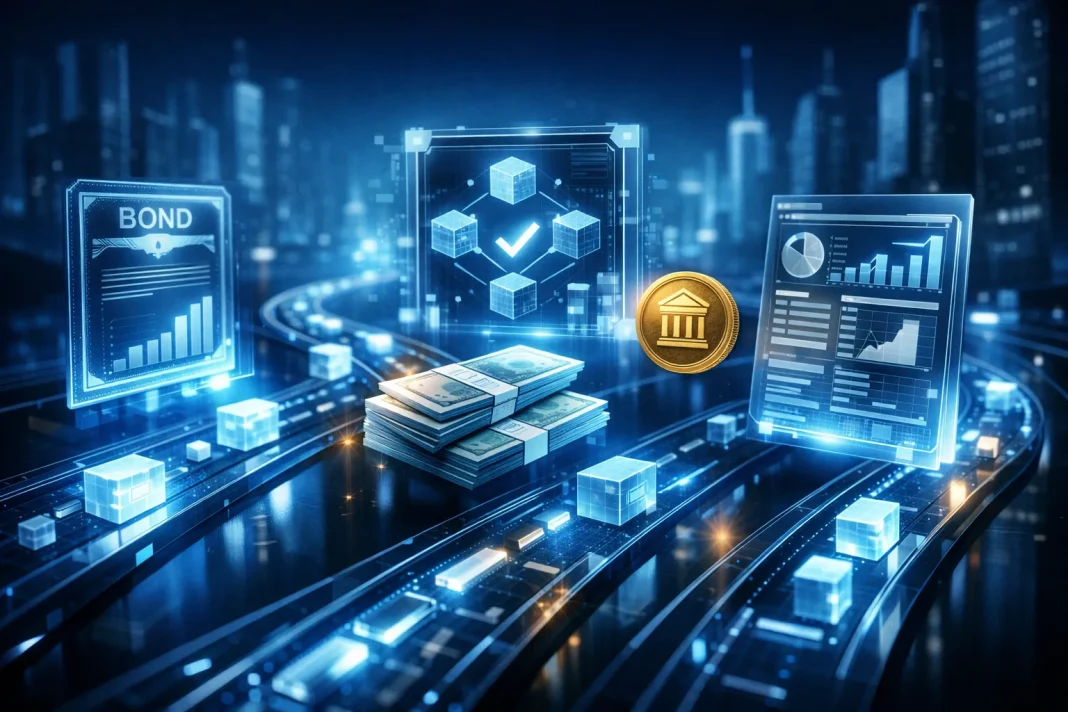
Real-world assets in crypto are becoming one of the most important long-term trends in Web3 because they connect blockchain infrastructure to assets that already matter in traditional finance. Chainlink’s RWA explainer defines tokenized real-world assets as blockchain-based digital tokens representing physical and traditional financial assets such as cash, commodities, equities, bonds, and credit, while Ethereum’s RWA page frames the category as a bridge between traditional finance and blockchain networks.
That shift matters.
For years, a large part of crypto was judged mainly through speculation. Markets focused on token prices, narratives, and short-term trading cycles. But RWAs point in a different direction. They ask whether blockchain can improve how real assets are issued, transferred, settled, and accessed.
That is why institutional interest is growing.
BlackRock CEO Larry Fink’s 2026 annual letter argued that tokenization could update the plumbing of finance by making investments easier to issue, trade, and access. BCG’s tokenized funds research has also argued that tokenized funds are moving from experiment toward a meaningful asset-management trend.
If you already read our articles on USDT vs USDC vs DAI: Which Stablecoin Is Best for Real-World Payments?, Smart Contracts Explained: The Essential Web3 Technology You Need to Understand, Crypto ETFs Explained: How Bitcoin & Ethereum ETFs Are Changing the Financial World, Stablecoins vs SWIFT Payments, and BlackRock Expands Tokenized Asset Strategy on Ethereum, then this article is the next step. Those pieces explain crypto access, payments, and blockchain logic. This one explains why institutions are looking at tokenization as infrastructure.
Real-World Assets in Crypto explained for beginners
The simplest way to understand real-world assets in crypto is this:
They are blockchain-based representations of assets that exist outside purely native crypto markets.
That can include:
- government bonds
- money market funds
- private credit
- commodities
- equities
- real estate exposure
- invoices
- other financial claims
Chainlink’s RWA guide describes them as tokens representing physical and traditional financial assets, and Ethereum’s overview of RWAs similarly presents them as traditional assets brought onchain through tokenization.
This is important because it changes what blockchain is being used for.
Instead of only creating value inside crypto itself, tokenization tries to connect blockchain rails with assets that already exist in the real economy.
1. RWAs give blockchain a stronger real-economy use case
A lot of crypto sectors are driven by narrative energy. RWAs are different because the core story is not hype. The story is infrastructure.
If an asset can move through blockchain-based systems, several things may improve:
- settlement speed
- transfer transparency
- automation
- reporting
- programmability
- access models
- collateral mobility
This is one reason institutions care. The value is not only in putting an asset onchain. The value is in making the asset easier to integrate into digital systems.
2. Institutions care about efficiency, not only innovation
Institutions are not suddenly becoming retail-style crypto enthusiasts.
They are interested because RWAs offer a more familiar and commercially serious use case.
A large financial institution may not care about meme coins or speculative token culture. But it does care about:
- settlement efficiency
- asset servicing
- compliance workflows
- collateral use
- reporting
- transparency
- investor access
- operational cost reduction
That is why tokenization is getting traction.
Reuters reported on March 24, 2026 that NYSE is partnering with Securitize to develop a tokenized securities platform. Reuters also reported earlier in March 2026 that the SEC approved a Nasdaq proposal to allow trading and settlement of certain stocks in tokenized form. Those are meaningful signs that tokenization is moving deeper into institutional market infrastructure.
3. Stablecoins already proved tokenization can work
One of the easiest ways to understand real-world assets in crypto is to look at stablecoins first.
Stablecoins already proved that tokenized representations of fiat-linked value can become useful in payments, settlement, and digital finance. In that sense, stablecoins were one of the first major successful tokenization stories.
RWAs build on the same logic.
If tokenized dollars can move onchain, then tokenized financial assets can potentially use similar rails for settlement, collateral, and integration with digital applications.
That is why this topic connects naturally with our article on USDT vs USDC vs DAI and our analysis of Stablecoins vs SWIFT Payments.
4. The most serious RWA examples are often the least flashy
Many readers imagine tokenization mainly through flashy examples like luxury real estate or collectibles.
But some of the most serious institutional use cases are actually more boring:
- tokenized US Treasuries
- money market exposure
- private credit
- tokenized funds
- collateralized claims
That may sound less exciting than speculative narratives, but that is exactly why the category matters.
Boring finance at scale is often more valuable than exciting finance in theory.
MetaMask’s March 2026 RWA overview said tokenized US Treasuries had surpassed $11 billion in onchain value, showing how much institutional and user interest is building around tokenized yield-bearing assets.
5. Smart contracts make tokenized assets programmable
The strongest RWA argument is not just that assets can exist onchain.
The stronger argument is that they can become programmable.
Once an asset lives within blockchain-compatible infrastructure, new things become possible:
- automated settlement
- better transfer logic
- programmable access rules
- yield distribution
- more flexible collateral use
- easier integration with digital applications
That is why this topic connects directly to our article on Smart Contracts Explained. RWAs are where smart contracts start looking commercially serious, not just technically interesting.
6. Tokenization is hard because it must connect code, law, and markets
If RWAs are so promising, why is adoption still slower than hype-driven sectors?
Because tokenization is not only a technical problem.
It is also a legal, regulatory, operational, and market-structure problem.
A token can represent an asset, but important questions still remain:
- who legally owns what
- how redemption works
- what investor rights exist
- how compliance is enforced
- how disputes are handled
- how deep liquidity really is
- whether the onchain structure matches the offchain legal structure
This is why many RWA projects will fail or stay limited.
Tokenization is harder than launching a speculative token because it has to connect software, law, regulation, and real financial processes.
7. RWAs may outlast many other crypto narratives
A strong crypto theme usually survives even after excitement fades.
RWAs have a real chance to do that because their value does not depend only on retail speculation. Their value depends on whether blockchain can make real financial systems more efficient and more programmable.
That is a much stronger foundation than many short-cycle narratives.
If meme hype weakens, the use case can vanish quickly.
If NFT speculation drops, volumes can collapse.
But if tokenized assets improve settlement, servicing, or capital movement, the core use case can remain valuable even in a colder market.
This is why real-world assets in crypto may become one of the most serious long-term categories in Web3.
Final verdict
So what are real-world assets in crypto?
They are tokenized representations of traditional financial or physical assets brought into blockchain-based systems.
Why are institutions interested?
Because tokenization promises something institutions already care about:
- better infrastructure
- faster settlement
- more automation
- cleaner reporting
- programmable finance
- broader digital access
That does not mean every RWA project will succeed.
But it does mean this category deserves to be taken more seriously than many short-lived crypto narratives.
And that is why understanding real-world assets in crypto is becoming one of the best ways to understand where serious Web3 adoption may go next.understand where serious Web3 adoption may go next.
❓ FAQ
What are real-world assets in crypto?
Real-world assets in crypto are blockchain-based tokens that represent traditional financial or physical assets such as bonds, funds, credit, commodities, or real estate-related exposure.
Why are institutions interested in RWAs?
Institutions are interested because tokenization can improve settlement, automation, reporting, access, and financial infrastructure. BlackRock and BCG have both highlighted tokenization as a meaningful structural opportunity.
Are stablecoins considered part of the RWA story?
They are closely connected. Stablecoins are one of the clearest examples of tokenized fiat-linked value moving onchain, and they help explain why broader tokenization is attractive.
What kinds of assets are being tokenized?
Common examples include Treasuries, money market exposure, private credit, tokenized funds, and other financial claims. Tokenized US Treasuries alone exceeded $11 billion in onchain value by March 2026, according to MetaMask’s overview.
Does tokenization automatically improve finance?
No. Some projects only add a blockchain wrapper without meaningfully improving usability, settlement, transparency, or access. The strongest projects are the ones that improve actual financial processes.
