
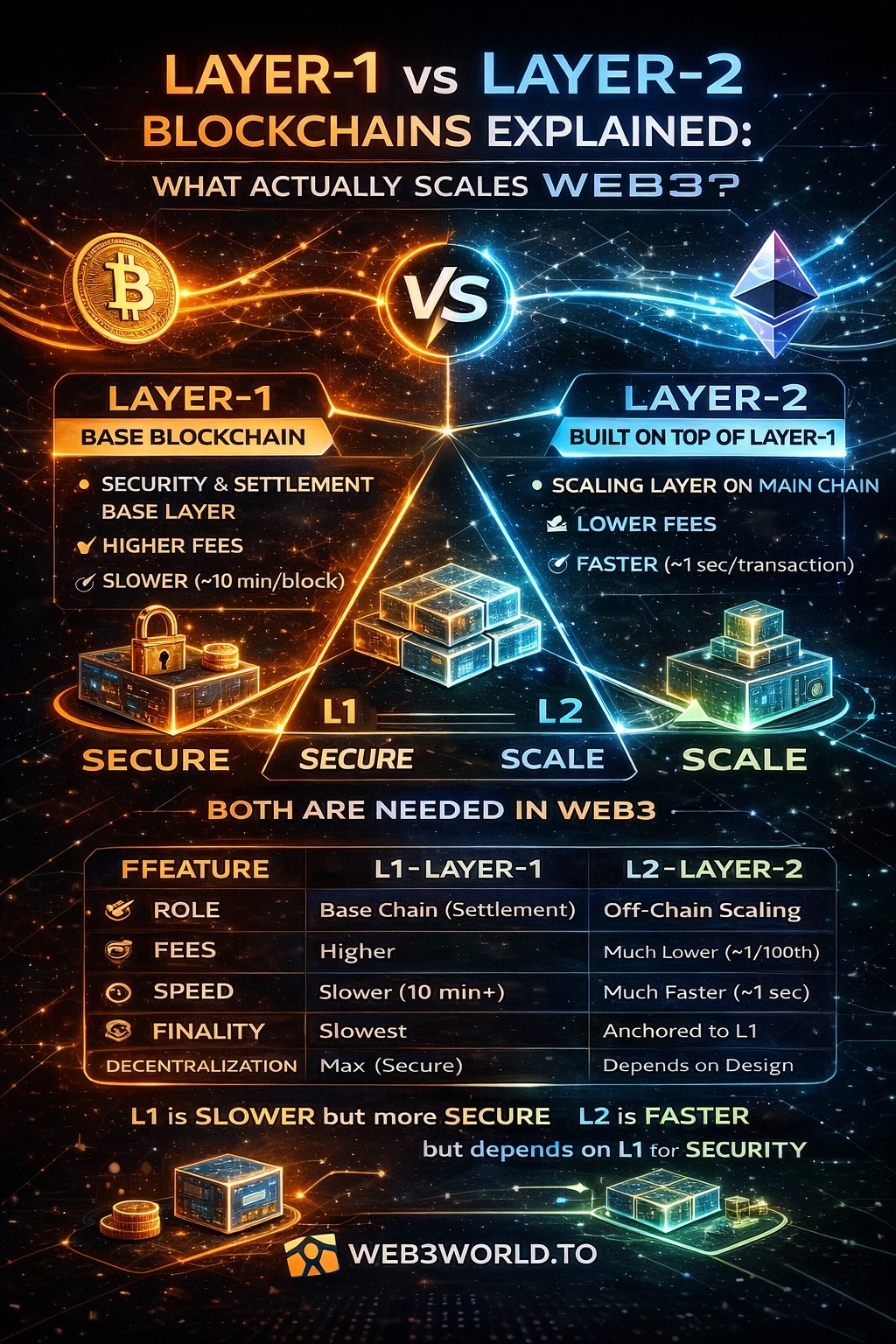
As blockchain adoption grows, one question keeps returning:
Why are transactions slow and expensive — and how does Web3 scale?
The answer lies in the difference between Layer-1 and Layer-2 blockchains. While they are often discussed together, they solve very different problems and play complementary roles in the Web3 ecosystem.
This guide explains what Layer-1 and Layer-2 really are, how they work, and why both are necessary.
What Is Layer-1? (The Base Blockchain)
Layer-1 (L1) is the main blockchain itself.
Examples include:
- Bitcoin
- Ethereum
Layer-1 is responsible for:
- Consensus
- Security
- Final settlement
- Native token issuance
Every transaction recorded on Layer-1 becomes part of the permanent blockchain history.
Why Layer-1 Blockchains Don’t Scale Easily
Layer-1 blockchains prioritize:
- Decentralization
- Security
- Immutability
This creates natural limits:
- Fixed block size
- Block time constraints
- Global state replication
If Layer-1 simply increased throughput:
- Node requirements would rise
- Decentralization would drop
- Fewer people could run nodes
This trade-off is known as the blockchain trilemma.
What Is Layer-2? (Scaling on Top of Layer-1)
Layer-2 (L2) solutions are secondary networks built on top of Layer-1.
They:
- Process transactions off the main chain
- Bundle (roll up) many transactions
- Settle final results back on Layer-1
Layer-2 inherits Layer-1 security, but avoids Layer-1 congestion.
How Layer-2 Works (Simplified)
- Users transact on Layer-2
- Transactions are processed quickly
- Data is compressed
- Final proof is submitted to Layer-1
Layer-1 acts as:
✔️ Judge
✔️ Settlement layer
✔️ Security anchor
Types of Layer-2 Solutions
1️⃣ Rollups
- Bundle many transactions into one
- Most popular L2 approach
Optimistic Rollups
- Assume transactions are valid
- Allow challenge period
Zero-Knowledge Rollups
- Use cryptographic proofs
- Faster finality
- Higher complexity
2️⃣ State Channels
- Two parties transact off-chain
- Only open/close on Layer-1
- Limited flexibility
3️⃣ Sidechains (Not True L2)
- Separate consensus
- Independent security
- Faster but riskier
Important: Sidechains ≠ Layer-2 in strict terms.
Layer-1 vs Layer-2: Key Differences
| Feature | Layer-1 | Layer-2 |
|---|---|---|
| Role | Security & settlement | Scaling & speed |
| Fees | Higher | Much lower |
| Speed | Slower | Near-instant |
| Decentralization | Maximum | Depends on design |
| Finality | Strong | Anchored to L1 |
Bitcoin Layer-2 vs Ethereum Layer-2
Bitcoin Layer-2
Focus:
- Payments
- Speed
- Low fees
Layer-2 handles frequent transfers while Bitcoin remains the global settlement layer.
Ethereum Layer-2
Focus:
- Smart contracts
- DeFi
- NFTs
- High-throughput apps
Ethereum Layer-2 expands functionality without overloading the base chain.
Why Layer-2 Does NOT Replace Layer-1
A common misconception is that Layer-2 makes Layer-1 irrelevant.
Reality:
- Layer-2 depends on Layer-1
- Layer-1 provides final security
- Layer-2 provides usability
They are symbiotic, not competitive.
Security Trade-Offs to Understand
Layer-2 security depends on:
- Proof systems
- Fraud detection
- Data availability
- Governance design
Poorly designed Layer-2 systems can:
- Freeze withdrawals
- Centralize control
- Introduce new risks
Understanding trust assumptions is critical.
Why Layer-2 Is Essential for Mass Adoption
Without Layer-2:
- Fees remain high
- UX suffers
- Micro-transactions are impossible
With Layer-2:
✔️ Cheap transactions
✔️ Faster confirmations
✔️ Better user experience
Layer-2 makes Web3 usable — Layer-1 makes it trustworthy.
Final Thoughts
Layer-1 blockchains are slow by design — and that’s a feature, not a flaw.
Layer-2 solutions unlock:
- Scale
- Speed
- Usability
Together, they form the foundation for Web3’s future.
At Web3World.to, we explain Web3 without hype, without shortcuts, and without confusion.
