
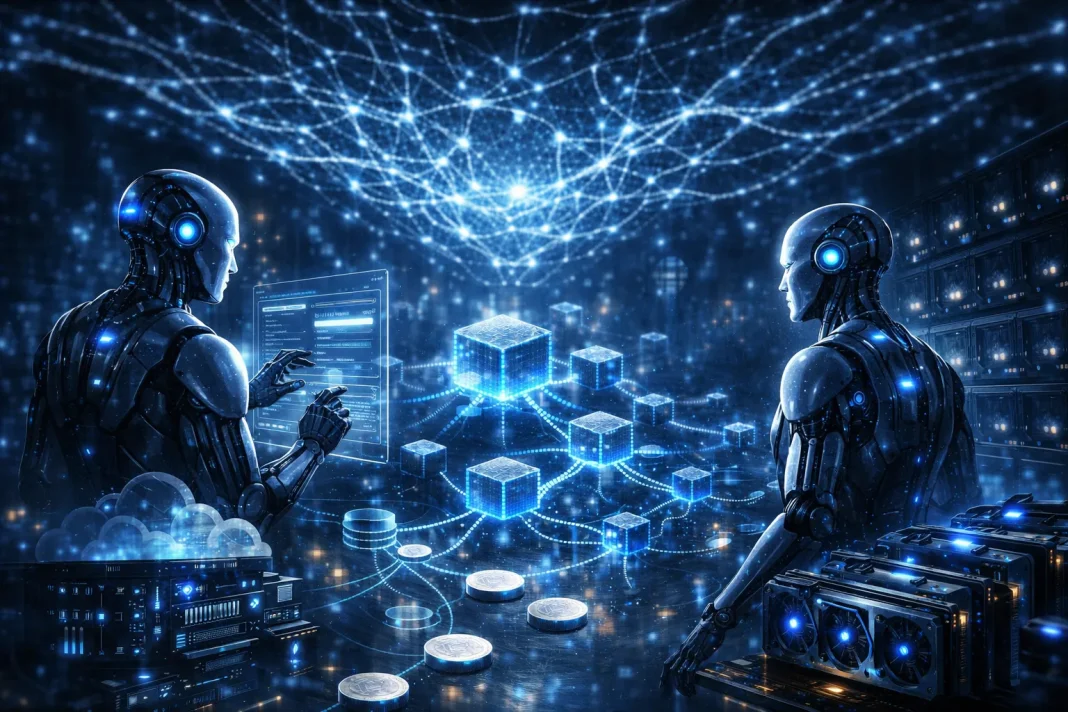
The Internet of Agents: Why Web3 + AI Could Create a Machine-to-Machine Economy
The next big Web3 + AI story may not be chatbots, image generators, or another wave of speculative AI tokens. It may be something much larger: an Internet of Agents, where autonomous software can discover services, negotiate, pay, execute tasks, and coordinate with other agents across open networks.
For years, AI and crypto were treated as separate worlds. AI was about prediction and automation. Web3 was about ownership and trustless value transfer. But as AI agents become more autonomous, they start needing what blockchains already provide: wallets, payments, persistent identity, verifiable rules, and programmable coordination. That is why the real long-term convergence of Web3 and AI may be less about hype and more about machine-native economic infrastructure.
If your readers already followed your article on AI-powered wallets and institutional crypto adoption, this is the next step in that story. Instead of asking how AI helps humans use crypto better, this article asks a bigger question: what happens when AI itself becomes an active economic participant inside Web3? That internal topic cluster fits your current publishing direction.
Why this narrative is different
Most Web3 + AI content focuses on the same themes: decentralized compute, AI trading bots, or tokenized data marketplaces. Those topics matter, but they still describe AI mostly as a tool for humans.
The more radical shift is this: AI agents may become direct economic actors.
That means an agent could rent GPU power, buy data access, execute a smart contract, monitor markets, rebalance a treasury, pay another agent for a service, and leave an auditable transaction trail without waiting for a human to approve every small step.
This is where Web3 becomes essential. Traditional internet rails were not built for autonomous software entities that need instant payments, open access, and verifiable coordination. Blockchains were.
From users to agents
The internet today is still designed mainly around human users. Apps assume a person is clicking, logging in, typing, browsing, and paying. But if AI agents become persistent actors, that model starts to break.
A serious agent economy needs five things: identity, payments, compute, interoperability, and verifiability.
Identity matters because the network must know which agent is acting and under what permissions.
Payments matter because agents need to send and receive value instantly, often in very small amounts. That is where stablecoins become much more than a finance story. Your post on Could Stablecoins Replace SWIFT? How Blockchain Payments Are Challenging the Global Banking System fits naturally here, because machine-to-machine commerce would need faster and more programmable rails than traditional banking can offer.
Compute matters because agents need inference, memory, orchestration, and sometimes high-performance hardware. This is why projects like Akash Network are so relevant to the Web3 + AI narrative: decentralized compute marketplaces could become part of the base layer for autonomous services. Akash presents itself as an open cloud marketplace with AI-focused positioning.
Interoperability matters because agents need to communicate and coordinate across systems, wallets, protocols, and applications.
Verifiability matters because if an agent makes a decision or executes a transaction, there must be some way to audit what happened, what rules were followed, and who authorized it.
Why Web3 may matter more to AI than AI matters to Web3
Many investors ask which AI-related crypto token could benefit most from hype. But the more important question is different: what parts of the AI economy require crypto rails to function properly?
As AI systems become more capable, the internet will face growing problems around trust, authenticity, payments, access, and digital ownership. AI can generate content, automate workflows, and simulate human behavior at scale. That means proving identity, tracking execution, controlling permissions, and settling value may become even more important than they are today.
This is where blockchain becomes useful in a deeper way. Web3 is not just a speculative layer. It can serve as infrastructure for authorization, ownership, payments, and machine coordination.
For readers coming from your more institutional content, this also connects naturally with Crypto ETFs Explained: How Bitcoin & Ethereum ETFs Are Changing the Financial World. ETFs represent institutional access to crypto as an asset class, while Web3 + AI points toward crypto as infrastructure for autonomous digital economies. Those are very different stories, but together they show how the market is maturing beyond pure speculation.
The infrastructure stack of the Internet of Agents
This future will probably not be built by one project. It will emerge in layers.
1. Compute markets
Before agents can do useful work, they need access to compute. That is why decentralized compute may become one of the strongest bridges between AI and Web3.
This section pairs naturally with your existing guide on DePIN Explained: The Web3 Model That Could Rebuild Real-World Infrastructure. In many ways, decentralized AI compute is the digital cousin of DePIN: instead of coordinating physical devices in the real world, the network coordinates computational supply for intelligent systems. Your site already frames DePIN as infrastructure, which makes it a strong internal link for this argument.
Projects like Bittensor also matter here because they position decentralized machine intelligence as an open network where contributors are rewarded based on useful output. Bittensor’s official documentation presents the ecosystem as a subnet-based marketplace for digital commodities including AI-related services.
2. Agent identity and authorization
This may become one of the most important parts of the stack. The current internet has login systems for humans, not sovereign software actors. But an agent economy needs delegated permissions, revocable credentials, and bounded authority.
In practice, that means wallets, decentralized identifiers, attestations, permissions frameworks, and reputation systems may all converge here.
3. Payment and settlement
Agents cannot become true economic actors without money rails. Blockchains make that possible because they allow programmable, global, always-on settlement.
This is why stablecoins could become even more important than many people realize. Human commerce is only part of the story. Machine commerce may be a much larger long-term market. That makes your article on stablecoins replacing SWIFT a highly relevant internal link in this section, because it helps readers understand why traditional payment networks may not fit the pace of autonomous digital transactions.
4. Agent coordination and markets
Eventually, we may see networks where agents buy services from other agents: research, compute access, data validation, monitoring, execution, optimization, and settlement.
That is much more interesting than the shallow version of “AI in crypto,” because it points toward a real economic system rather than a branding trend.
This also overlaps with your analysis article Is DeFi Actually Used in 2026 — or Just for Traders? because DeFi could become a financial operating layer not just for human traders, but for autonomous software handling liquidity, payments, and automated financial decisions. The article is listed on your homepage as one of your latest stories.
Why this could become a major Web3 theme
This narrative is strong because it connects several existing crypto themes into one larger framework.
Stablecoins provide payment rails. DePIN provides infrastructure. Wallets and account abstraction improve machine usability. Identity systems enable permissioned delegation. Smart contracts create programmable rules. Open networks allow autonomous participation.
That means Web3 + AI is not one isolated niche. It may become the point where many of crypto’s most important infrastructure layers finally work together.
That also gives your site a stronger editorial edge. Instead of publishing another generic “top AI coins” article, you can position your content around a more advanced thesis: the rise of machine-native economies built on Web3 rails.
The risks nobody should ignore
This future is powerful, but it is not risk-free.
A world of autonomous software with wallets and transactional authority creates new attack surfaces. A compromised or manipulated agent could move funds, interact with malicious contracts, or make damaging decisions at machine speed.
There are also softer risks: poor identity controls, weak permissions, fake agent reputations, unreliable tool use, bad incentive design, and unclear legal accountability when something goes wrong.
So the projects that win in this space will not just be the most exciting ones. They will be the ones that combine autonomy with strong safeguards, verifiability, and sustainable economic design.
What this means for investors and builders
For investors, the main lesson is that the best Web3 + AI opportunities may not look like obvious hype trades at first. The most valuable projects may be the infrastructure layers that quietly make autonomous coordination possible.
For builders, the opportunity is even bigger. If you can create tools that make agents easier to identify, authorize, coordinate, pay, or verify, then you are not just building another crypto app. You may be building part of the operating system for a machine economy.
That also ties back to your earlier article on AI-powered wallets and institutional crypto adoption, because wallets may evolve from user tools into programmable interfaces for agent-based finance and coordination.
Final thoughts
The most valuable Web3 + AI idea may not be decentralized chatbots or tokenized models. It may be the creation of an Internet of Agents where autonomous systems can coordinate economically across open rails.
If that happens, the internet changes in a very deep way. It stops being only a network of websites, apps, and human users. It becomes a network of humans and machines transacting, negotiating, and creating value together.
That is why this topic matters.
Web3 gives AI something centralized systems struggle to provide at internet scale: open payments, programmable ownership, verifiable coordination, and machine-native access to economic rails. AI gives Web3 something it has often lacked: a reason for autonomous on-chain activity beyond speculation.
Put those two together, and the result could become one of the most important infrastructure shifts of the decade.
❓ FAQ
What is the Internet of Agents?
The Internet of Agents is a possible future internet model where autonomous AI agents can communicate, transact, and coordinate with each other across open digital networks.
Why do AI agents need blockchain?
AI agents need blockchain because it provides programmable payments, persistent identity, verifiable execution, and open coordination without relying on a single platform.
How does Web3 help AI?
Web3 helps AI by adding wallets, smart contracts, stablecoin payments, decentralized compute access, and ownership rails that autonomous software can use directly.
What is a machine-to-machine economy?
A machine-to-machine economy is a system where software agents, devices, or autonomous systems exchange services and payments without constant human involvement.
What are the biggest use cases of Web3 + AI agents?
The biggest use cases include decentralized compute markets, autonomous payment flows, AI-powered DeFi execution, agent-based commerce, and on-chain identity systems.
