
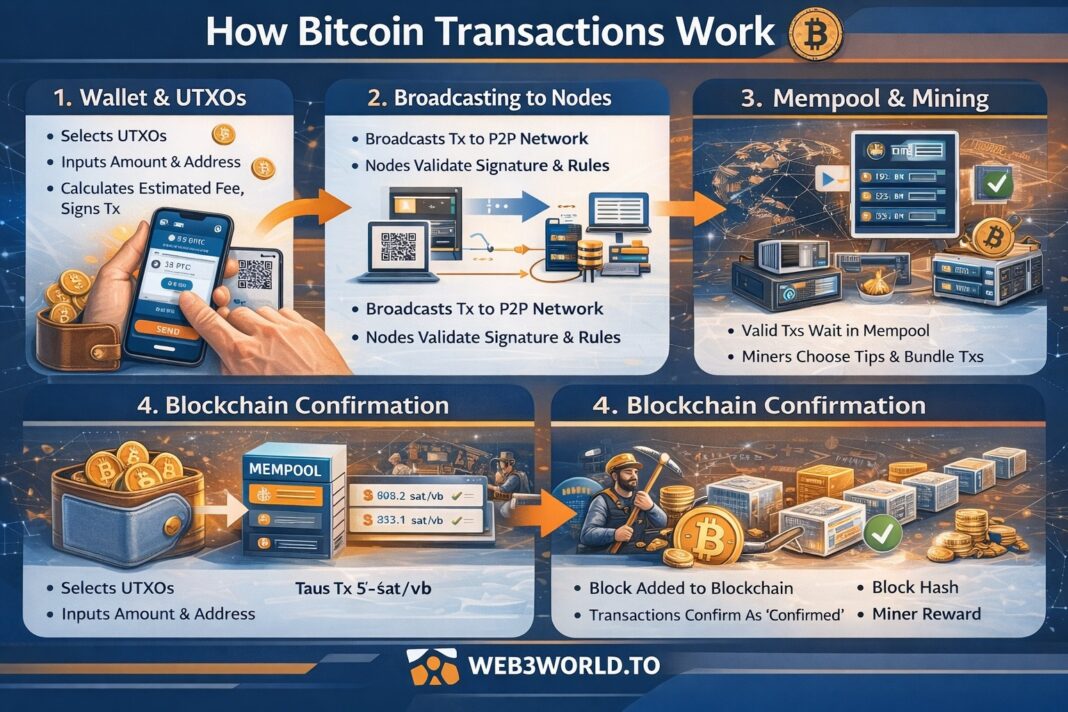
Bitcoin transactions look simple on the surface — click “send,” wait, and receive confirmation. But under the hood, a complex cryptographic and economic process ensures security, decentralization, and trust without intermediaries.
This guide explains how Bitcoin transactions work step by step, from wallet creation to final confirmation on the blockchain.
What Is a Bitcoin Transaction?
A Bitcoin transaction is a digitally signed message that transfers ownership of bitcoin (BTC) from one address to another.
Unlike banks:
- No accounts
- No names
- No central authority
Instead, Bitcoin uses cryptographic keys, unspent outputs (UTXOs), and network consensus.
Bitcoin Wallets: Public Keys, Private Keys & Addresses
A Bitcoin wallet does not store coins. It stores keys.
Private Key
- Secret number
- Proves ownership
- Never shared
Public Key
- Derived mathematically from private key
- Used to verify signatures
Bitcoin Address
- A hashed, shortened version of the public key
- Safe to share publicly
👉 If you control the private key, you control the bitcoin.
UTXO Model: How Bitcoin Tracks Balances
Bitcoin does not use balances like banks or Ethereum accounts.
Instead, it uses UTXOs (Unspent Transaction Outputs).
How UTXOs Work
- Each transaction creates outputs
- Outputs can only be spent once
- Wallet balance = sum of all unspent outputs
Example:
- You receive 0.5 BTC
- You later spend 0.3 BTC
- New outputs are created:
- 0.3 BTC to recipient
- 0.2 BTC back to you (change)
This design improves security and parallel validation.
Creating a Bitcoin Transaction (Step by Step)
1️⃣ Transaction Construction
Your wallet:
- Selects UTXOs
- Defines recipient address
- Calculates fee
- Adds change output
2️⃣ Digital Signature
The transaction is signed using your private key.
✔️ Proves ownership
✔️ Prevents tampering
✔️ Cannot be forged
Transaction Fees: Why They Matter
Bitcoin fees are not fixed.
They depend on:
- Transaction size (bytes, not BTC amount)
- Network congestion
- Fee rate (satoshis per byte)
Why Fees Exist
- Incentivize miners
- Prevent spam
- Prioritize transactions
Higher fee ⇒ faster confirmation
Lower fee ⇒ longer wait
Broadcasting to the Bitcoin Network
Once signed, the transaction is:
- Broadcast to nearby nodes
- Validated for rules compliance
- Stored in the mempool (waiting area)
Nodes check:
- Signature validity
- No double-spending
- Proper formatting
- Sufficient fees
Invalid transactions are rejected instantly.
Mining & Block Inclusion
Miners select transactions from the mempool and include them in a block.
Priority is usually given to:
- Higher fee rate
- Smaller size
- Valid scripts
Once mined:
- Transaction gets 1 confirmation
- Each additional block adds another confirmation
How Many Confirmations Are Needed?
| Use Case | Recommended Confirmations |
|---|---|
| Small payments | 1–2 |
| Exchanges | 3–6 |
| Large transfers | 6+ |
After 6 confirmations, reversing a transaction is economically impractical.
Why Bitcoin Transactions Are Secure
Cryptography
- Digital signatures
- One-way hash functions
Decentralization
- Thousands of independent nodes
- No single point of failure
Economic Security
- Proof-of-work
- High cost to attack the network
Common Bitcoin Transaction Types
- P2PKH – Legacy transactions
- P2SH – Script-based (multi-sig)
- SegWit (Bech32) – Lower fees, faster
- Taproot – Enhanced privacy and efficiency
Modern wallets default to SegWit or Taproot.
Bitcoin Transaction Speed: Myths vs Reality
❌ Myth: Bitcoin is slow
✅ Reality: Bitcoin prioritizes security over speed
Layer-2 solutions (like Lightning) handle instant payments while Bitcoin remains the settlement layer.
Why Transactions Cannot Be Reversed
Bitcoin transactions are:
- Immutable
- Final after confirmations
- Not chargeback-based
This makes Bitcoin ideal for:
✔️ Global payments
✔️ Censorship resistance
✔️ Trust-minimized transfers
But it also means users must be careful.
Bitcoin transactions are not just payments — they are cryptographic proofs secured by mathematics, energy, and decentralized consensus.
Understanding how transactions work gives you:
- Better fee control
- Improved security
- Deeper insight into Web3 infrastructure
At Web3World.to, we break down complex blockchain systems into clear, actionable knowledge.
Related Articles:
Bitcoin vs Ethereum Transactions: Key Differences Explained Simply
