
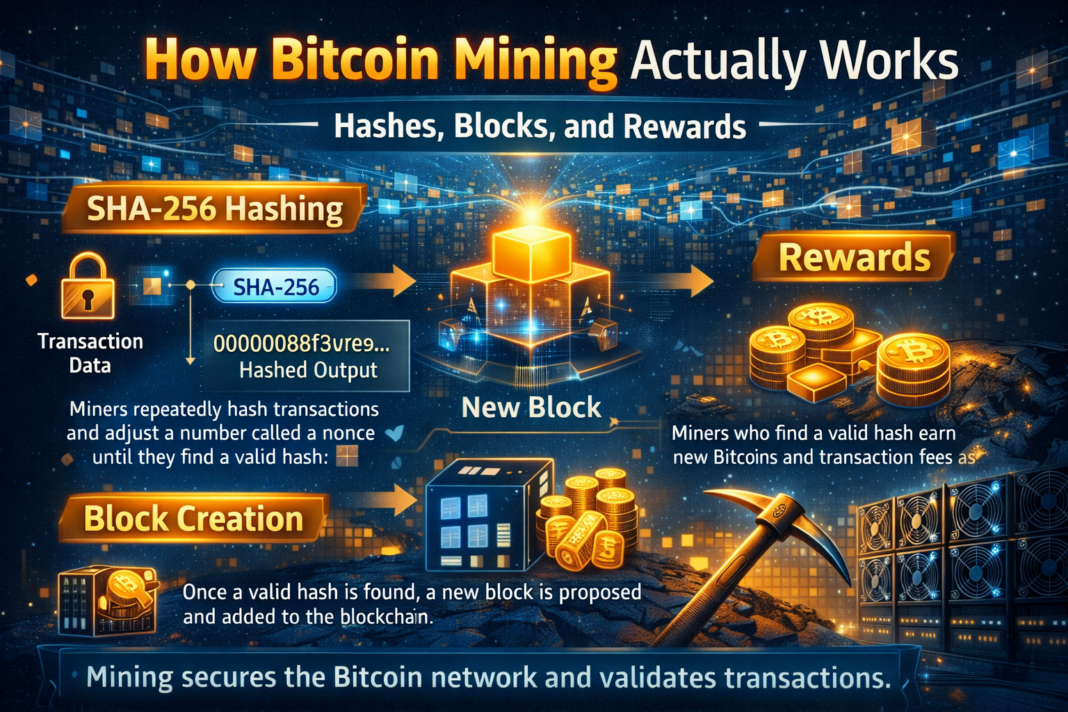
Mining is the core process that powers the Bitcoin blockchain. It ensures that transactions are verified, blocks are added to the blockchain, and the network remains secure without relying on any central authority.
The mining system was designed by Satoshi Nakamoto as a decentralized way to validate transactions while preventing fraud or double spending.
But how does Bitcoin mining actually work behind the scenes?
To understand the process, we need to look at three key components:
- SHA-256 hashing
- block creation
- mining difficulty
Together, these mechanisms form the foundation of the Bitcoin network.
What Happens When a Bitcoin Transaction Is Sent
Every time someone sends Bitcoin, the transaction is broadcast to the global network of nodes.
Nodes are computers that maintain a copy of the blockchain and verify new transactions.
These transactions enter a pool of pending transactions known as the mempool. Miners then select transactions from this pool and group them into a new block.
Before a block can be added to the blockchain, miners must solve a complex cryptographic puzzle.
This puzzle is based on hashing.
SHA-256 Hashing Explained
The Bitcoin network relies on a cryptographic algorithm called SHA-256.
A hash function takes an input of any size and produces a fixed-length output called a hash.
For example:
Input:
Bitcoin transaction data
Output:
0000008f3a7e9c4a2b...
Even the smallest change in the input will produce a completely different hash.
This property makes hashing extremely useful for security.
Mining involves repeatedly generating hashes until one meets the requirements set by the network.
The Role of Nonces in Mining
When miners attempt to create a valid block, they repeatedly change a number called a nonce.
The nonce is simply an arbitrary number used in the hashing process.
Miners combine:
- transaction data
- previous block hash
- timestamp
- nonce
This data is hashed using SHA-256.
If the resulting hash meets the network’s difficulty requirement, the block is considered valid.
If not, the miner changes the nonce and tries again.
This process happens billions or even trillions of times per second.
How Blocks Are Created
Once a miner finds a valid hash, a new block is created and broadcast to the network.
Each block contains several important components:
- transaction list
- timestamp
- previous block hash
- block reward transaction
- nonce
The reference to the previous block hash links each block together, forming the blockchain.
This chain structure makes it extremely difficult to alter past transactions because changing one block would require recalculating every block after it.
Bitcoin Mining Difficulty
To keep the network stable, Bitcoin adjusts the difficulty of mining automatically.
The goal is to maintain an average block creation time of 10 minutes.
The difficulty adjusts every 2016 blocks, roughly every two weeks.
If more miners join the network and the hash rate increases, the difficulty rises.
If miners leave the network, the difficulty decreases.
This dynamic adjustment ensures the network operates smoothly regardless of how much computational power is participating.
Why Mining Secures the Network
Bitcoin mining requires enormous computational work.
Because of this, attacking the network would require controlling a massive amount of computing power.
The cost of such an attack would be extremely high, making the system secure.
Mining also ensures that transactions cannot be easily reversed or manipulated once confirmed.
Mining Rewards and Incentives
Miners are incentivized to participate through rewards.
When a miner successfully adds a new block to the blockchain, they receive:
- newly created Bitcoin (block reward)
- transaction fees included in the block
Over time, the block reward decreases through events known as Bitcoin halvings.
Eventually, the total supply will reach the maximum limit of 21 million BTC.
At that point, miners will primarily earn revenue from transaction fees.
The Role of Mining Pools
Because mining has become highly competitive, many miners join mining pools.
A mining pool combines the computing power of multiple participants and distributes rewards among them based on their contributed hash power.
Large pools help stabilize earnings for miners who might otherwise wait years to mine a block individually.
Final Thoughts
Bitcoin mining is more than just a way to earn cryptocurrency. It is the mechanism that secures the entire network.
Through SHA-256 hashing, block creation, and dynamic difficulty adjustments, the system ensures that transactions are verified in a decentralized and trustless environment.
Even as technology evolves and mining hardware becomes more advanced, the fundamental principles behind Bitcoin mining remain the same.
Understanding how mining works provides valuable insight into how decentralized financial networks operate without centralized control.
Read more :
Complete Guide to Bitcoin Mining in 2026
