

Crypto ETFs for traditional investors are becoming one of the biggest bridges between old finance and digital assets. For years, many investors were curious about Bitcoin and Ethereum, but the practical barriers to entry were still too high. Buying crypto directly often meant opening a separate exchange account, learning wallet security, understanding private keys, and taking on custody responsibilities that many traditional investors did not want.
That is where crypto ETFs changed the conversation.
Instead of forcing investors to begin with wallets, exchanges, and self-custody, crypto ETFs created a more familiar way to gain exposure. They brought digital assets into a structure that traditional investors already understand: the exchange-traded fund. That shift matters because access is often the difference between interest and action.
In simple terms, crypto ETFs for traditional investors matter because they reduce friction. They make crypto exposure easier to understand, easier to access, and easier to place inside a normal brokerage account.
What is a crypto ETF?
A crypto ETF is an exchange-traded fund designed to give investors exposure to crypto-related assets through a traditional market product. Depending on the structure, that exposure may come from holding the underlying asset directly, using futures, or following another regulated framework.
The reason investors care is simple: they can buy ETF shares in a brokerage account without directly handling coins, private keys, or self-custody tools.
That difference became much more important after the U.S. SEC approved spot bitcoin ETP listings and trading.
BlackRock says the iShares Bitcoin Trust ETF seeks to reflect generally the performance of the price of bitcoin, while Grayscale says GBTC is solely and passively invested in Bitcoin and aims to reflect the value of Bitcoin held by the trust, less expenses and liabilities.
Why traditional investors were slow to enter crypto directly
To understand why crypto ETFs for traditional investors matter, it helps to understand why many traditional investors stayed away from direct crypto ownership in the first place.
The problem was not always lack of interest. In many cases, it was lack of comfort with the structure.
Traditional investors are used to:
- brokerage accounts
- regulated products
- familiar reporting systems
- portfolio allocation inside existing accounts
- advisor-led investment frameworks
Direct crypto ownership often feels very different. It introduces questions many traditional investors do not want to solve on day one:
- Which exchange should I use?
- How do I store the asset safely?
- What happens if I lose access?
- How do wallets and private keys work?
- Who handles custody and compliance?
That is why crypto ETFs for traditional investors became so important. The ETF structure reduces operational complexity and gives investors a more familiar entry point. This is also why topics like Hot Wallet vs Cold Wallet: The Essential Difference Every Beginner Should Know matter more for direct owners than for ETF buyers.
How crypto ETFs help traditional investors enter the market more easily
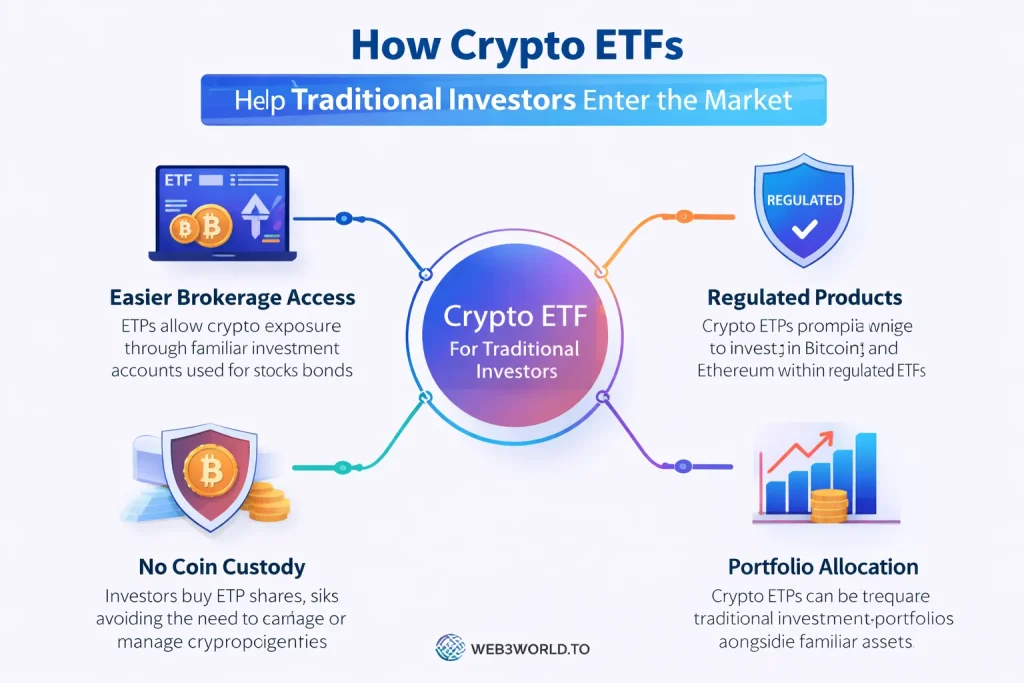
The biggest advantage is convenience.
Crypto ETFs for traditional investors allow exposure through the same systems many people already use for stocks, bonds, and other ETFs. That means an investor who has never used a crypto exchange may still gain exposure through a standard brokerage account.
That changes behavior.
Instead of asking traditional investors to become crypto-native first, ETFs let them approach the market through:
- familiar trading platforms
- standard portfolio dashboards
- existing tax and reporting systems
- regulated exchange-traded products
- normal investment account workflows
For many people, that is a major difference. It turns crypto from something that feels operationally foreign into something that fits inside an existing investment process.
Crypto ETFs reduce the custody problem
One of the biggest barriers to direct crypto ownership has always been custody.
Direct ownership means the investor has to think about wallet choice, exchange risk, private keys, phishing, and storage practices. That is manageable for experienced crypto users, but it can feel overwhelming to traditional investors.
Crypto ETFs for traditional investors reduce that burden because the investor is buying a security, not directly moving coins through a wallet.
That does not make the underlying asset less volatile, but it makes the operating model easier.
BlackRock’s IBIT product page states that shares may be bought or sold on the secondary market through any brokerage account, and the fund’s objective is to reflect generally the performance of the price of bitcoin.
That is a big reason crypto ETFs for traditional investors feel more approachable than native crypto ownership.
Why the ETF wrapper feels natural to traditional finance
The ETF structure already has credibility in traditional markets. Investors use ETFs for equity indexes, sectors, bonds, commodities, and thematic strategies. So when crypto arrives in that wrapper, it feels more familiar.
This is one of the clearest reasons crypto ETFs for traditional investors matter so much.
The product may be new, but the structure is not.
That matters for:
- retail investors using brokerage apps
- financial advisors
- wealth managers
- institutional allocators
- investors who want portfolio-based exposure instead of self-custody
This is also why crypto ETFs fit naturally into the broader discussion in Why Institutions Are Interested in Tokenized Finance. Traditional finance often engages more quickly when the infrastructure feels familiar.
Spot ETFs changed the conversation
The approval of spot bitcoin ETP shares in January 2024 was a turning point because it moved Bitcoin exposure into a more mainstream public-market format. The SEC statement on spot bitcoin ETP approvals made clear that access was expanding, even if the asset class itself remained risky.
That distinction is important.
The approval made access easier, but it did not remove asset risk.
It also opened the door for a much bigger conversation about what crypto exposure might look like inside conventional investment portfolios. Once investors see Bitcoin and Ethereum exposure inside recognizable ETF structures, the asset class becomes easier to discuss in traditional investment language.
Why advisors and institutions care about crypto ETFs
Traditional investors do not always make decisions in isolation. Many work through advisors, investment committees, or structured portfolio frameworks.
Crypto ETFs for traditional investors fit that world more naturally because they can be discussed through familiar concepts:
- asset allocation
- position sizing
- liquidity
- risk exposure
- fees
- reporting
- compliance
That makes the product easier to evaluate than direct coin ownership for many professionals.
Grayscale’s GBTC page makes clear that the fund is invested in Bitcoin and that an investment in the fund is not a direct investment in Bitcoin.
That is exactly why crypto ETFs for traditional investors matter: they separate exposure from direct operational handling.
Crypto ETFs do not remove crypto risk
This is where many beginners get confused.
Crypto ETFs for traditional investors make access easier, but they do not make the underlying asset safe.
If Bitcoin falls, a spot bitcoin ETF can still fall sharply. If crypto sentiment weakens, ETF investors still face market volatility. The product wrapper changes convenience and familiarity, but it does not remove asset risk.
The SEC’s statement also stressed that approval of these products did not mean approval or endorsement of bitcoin itself.
That is why crypto ETFs for traditional investors should be understood as an access tool, not a safety guarantee.
Crypto ETFs versus direct crypto ownership
The easiest way to compare them is this:
Direct crypto ownership often requires:
- exchange setup
- wallet decisions
- private key security
- transfer management
- onchain understanding
- personal custody responsibility
Crypto ETF exposure often requires:
- a brokerage account
- ETF trading access
- portfolio allocation decisions
- understanding product fees and structure
That is a major reason crypto ETFs for traditional investors appeal to people who are curious about Bitcoin or Ethereum but do not want to begin with wallets and custody tools.
If someone wants native Web3 participation, direct ownership still matters. Articles like Liquidity Pools Explained in Simple Words and What Do Blockchain Nodes Actually Do? show the deeper side of crypto infrastructure. ETFs are different. They are mostly about exposure, not native participation.
Why crypto ETFs may expand market participation
One of the biggest long-term effects of crypto ETFs is broader access.
Before ETFs, crypto exposure was often easiest for:
- exchange users
- self-custody-focused investors
- early adopters
- highly online retail traders
- crypto-native communities
Crypto ETFs for traditional investors expand that pool by making exposure available through systems already used in conventional investing.
That matters because mainstream participation usually grows when access becomes easier, not harder.
An investor does not need to become a full crypto power user to buy an ETF. They can begin with something much closer to the systems they already know.
Why perception changes when ETFs arrive
The ETF effect is not only mechanical. It is also psychological.
When an asset becomes available through a major ETF issuer and a regulated exchange-traded wrapper, many investors begin to view it differently. It can feel less fringe and more legible inside normal financial markets.
That does not prove the asset is good or bad. But it absolutely affects perception.
This is one reason crypto ETFs for traditional investors matter beyond flows and trading volumes. They help move digital asset exposure from the edge of the market toward the mainstream portfolio conversation.
The limits of crypto ETFs
Even though ETFs help with access, they also have limits.
They do not give investors native onchain utility. An ETF does not let someone:
- use DeFi applications
- send crypto onchain
- self-custody coins
- interact with smart contracts
- use stablecoins for payments
So crypto ETFs for traditional investors are mainly about exposure, not participation in the full Web3 ecosystem.
That is why articles like Stablecoins for Everyday Use: The Smart Alternative to Volatile Crypto still matter. ETFs help investors enter the market financially, but they do not replace the practical utility layer of crypto.
What traditional investors should still evaluate
Even with a familiar wrapper, investors still need to do real due diligence.
They should look at:
- product objective
- management fee
- liquidity
- tracking method
- issuer reputation
- underlying asset risk
- portfolio suitability
Both BlackRock’s ETF page and Grayscale’s ETF page show that structure, fees, and risks still matter even when the wrapper feels familiar.
So the wrapper may be familiar, but the need for careful evaluation remains.
Final thoughts
Crypto ETFs for traditional investors matter because access changes adoption.
They do not remove volatility.
They do not eliminate market risk.
They do not replace the native crypto economy.
But they do something very important: they make digital asset exposure easier to reach through familiar financial rails.
They simplify access.
They reduce direct custody friction.
They fit inside normal brokerage systems.
They create a bridge between old finance and digital assets.
For many traditional investors, the first step into crypto will not begin with a wallet.
It will begin with an ETF ticker.
❓ FAQ
What is a crypto ETF?
A crypto ETF is an exchange-traded fund that gives investors exposure to crypto-related assets through a traditional market structure.
Why do crypto ETFs help traditional investors?
Crypto ETFs for traditional investors help because they offer familiar brokerage access and reduce the need for direct coin custody.
Do crypto ETFs remove crypto risk?
No. They simplify access, but they do not remove the volatility or market risk of the underlying asset.
Are crypto ETFs the same as owning crypto directly?
No. ETF exposure is different from direct ownership because it does not provide native onchain utility like wallet-based ownership.
Why are spot bitcoin ETFs important?
They matter because the SEC approved the listing and trading of a number of spot bitcoin ETP shares in January 2024, which made Bitcoin exposure easier to access through traditional markets.
