

Blockchain nodes are one of the most important parts of the crypto world, yet many beginners do not fully understand what they actually do. People often hear about Bitcoin, Ethereum, DeFi, wallets, and smart contracts, but behind all of those systems there is a quieter layer of infrastructure working all the time.
That infrastructure is made up of blockchain nodes.
If blockchains are digital networks for recording and verifying transactions, then nodes are the machines that help those networks function. Without them, decentralized systems would not really be decentralized. In many cases, they would not work at all.
Understanding blockchain nodes helps people understand what gives blockchains their strength. It also makes it easier to see why decentralization is not just a slogan. It depends on real machines, real participants, and real network activity.
What are blockchain nodes?
The simplest way to describe blockchain nodes is this: they are computers or servers connected to a blockchain network.
These machines help the network perform important tasks such as:
- storing blockchain data
- sharing information with other nodes
- verifying transactions
- helping enforce network rules
- supporting consensus across the system
A node does not need to be a giant industrial server in every case. Depending on the blockchain and the node type, it may be run on different levels of hardware. But the main idea stays the same: a node is part of the network and helps it function.
This is one reason blockchains are different from traditional centralized systems. Instead of relying on one company’s database, blockchain networks distribute records and responsibilities across many nodes.
Why blockchain nodes matter
To understand why blockchain nodes matter, think about what would happen without them.
If there were no nodes, there would be no distributed ledger. There would be no shared transaction history. There would be no independent machines checking whether network rules were being followed. The whole idea of decentralization would become weak or meaningless.
Nodes matter because they help make blockchains:
- decentralized
- transparent
- resilient
- harder to censor
- harder to manipulate
This is why blockchain nodes are so important. They are not just background tools. They are part of the actual foundation of the network.
If you already read Smart Contracts Explained, then nodes are another major part of that same infrastructure layer. Smart contracts may define logic, but blockchain nodes help carry the network that makes those contracts usable.
What do blockchain nodes actually do?

At the most basic level, blockchain nodes help maintain the blockchain.
That involves several different tasks.
1. They store blockchain data
Many nodes keep a copy of some or all of the blockchain’s transaction history. This helps preserve the ledger and allows the network to remain distributed.
2. They verify transactions
When users send transactions, nodes help check whether those transactions follow the network’s rules. For example, they may help confirm that the digital signature is valid and that the sender actually has the right to move the funds.
3. They communicate with other nodes
Nodes do not work alone. They constantly share information with one another so the network can stay synchronized.
4. They enforce the rules of the network
Every blockchain has rules. Nodes help enforce them. If a transaction or block breaks the rules, nodes may reject it.
5. They help preserve decentralization
Because many different nodes participate, the system does not rely on a single central point of control.
So when someone asks what blockchain nodes actually do, the answer is not just one thing. They help the network store, verify, communicate, and remain independent.
Blockchain nodes and transaction verification
One of the most important roles of blockchain nodes is helping verify transactions.
Imagine someone sends crypto from one wallet to another. That action needs to be broadcast to the network. Nodes receive that information and check whether it is valid. They help make sure the transaction follows the protocol rules before it becomes part of the blockchain history.
This is one reason blockchain systems can function without relying entirely on one central authority. Verification is distributed across the network.
It is also why blockchain nodes are closely connected to trust. In a normal centralized system, users often trust a single institution’s records. In a blockchain network, trust is supported by the way nodes and consensus mechanisms work together.
If you want to understand how this connects to daily activity, it also helps to read Why Gas Fees Exist and What They Mean for Users, because every onchain action depends on infrastructure that includes nodes, validation, and network resources.
Are all blockchain nodes the same?
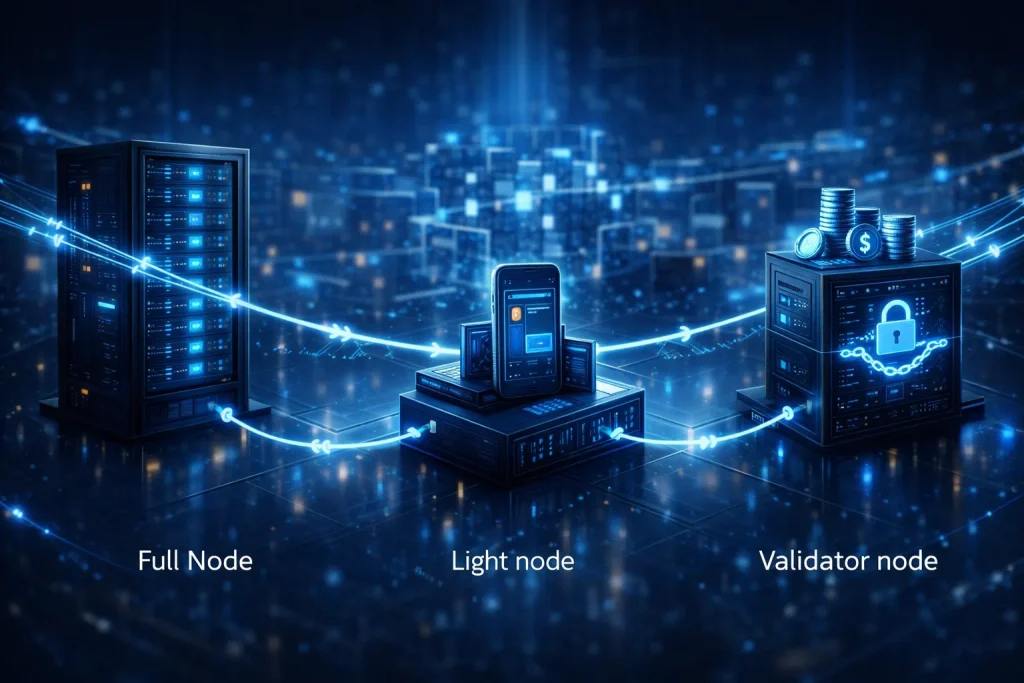
No. Not all blockchain nodes do the exact same job.
Different networks and systems have different kinds of nodes, and those nodes can play different roles. Some store full blockchain data, while others store less. Some are more directly involved in validation or consensus, while others mostly help relay information.
This matters because people sometimes hear the word “node” and imagine one single type of machine doing one identical task everywhere. In reality, the blockchain ecosystem uses several node models depending on the network design.
The most common categories beginners should understand are:
- full nodes
- light nodes
- validator nodes
You can see this infrastructure approach more clearly in the official Ethereum documentation on nodes and clients, which explains how different client types and node roles help support the Ethereum network.
What is a full node?
A full node usually stores a complete copy of the blockchain ledger and independently checks whether transactions and blocks follow the rules.
This is one of the most important forms of blockchain nodes because full nodes help preserve the integrity of the network. They do not just trust someone else’s version of the blockchain. They verify it themselves.
That independent verification is powerful.
It means a full node operator does not need to depend entirely on a third party to know what the valid blockchain state is. This is one of the strongest expressions of decentralization in practice.
What is a light node?
A light node stores less data than a full node and relies more heavily on the broader network for some information.
Light nodes are important because not every device can handle the storage and resource demands of a full node. Mobile wallets and lightweight applications often use lighter approaches so they can still interact with blockchain systems more efficiently.
This makes the ecosystem more practical.
Without lighter options, many ordinary users would have a harder time participating in blockchain networks through everyday devices.
So while full nodes are stronger from an independence perspective, light nodes help make access easier.
What is a validator node?
On some proof-of-stake networks, validator nodes play a major role in helping secure the blockchain and confirm new blocks.
Validator nodes are often associated with staking systems. These nodes may help propose or validate blocks depending on the design of the network.
This is where blockchain nodes connect directly to proof-of-stake security. If you have already read Proof of Work vs Proof of Stake: The Essential Guide to What Actually Secures a Blockchain, then validator nodes are one of the real infrastructure pieces behind that system.
They are not just abstract concepts. They are part of how the network stays operational and secure.
Blockchain nodes and decentralization
One of the biggest reasons people care about blockchain nodes is that they are tied directly to decentralization.
A blockchain can talk about being decentralized, but the real question is whether the network is actually distributed across enough independent participants.
Nodes help answer that question.
If a blockchain relies on only a tiny number of nodes, or if those nodes are heavily concentrated in one place or under one type of control, the network may be weaker than it appears. If a network has many independent nodes spread across different participants and locations, it is usually harder to censor, control, or disrupt.
This is why blockchain nodes matter so much beyond pure technical curiosity. They are one of the practical measurements of how real decentralization actually is.
Can anyone run blockchain nodes?
In many cases, yes — but it depends on the network and the kind of node.
Some blockchain nodes are easier to run than others. Some require more storage, more bandwidth, stronger hardware, or more technical understanding. Others are lighter and more accessible.
The key point is that many blockchain systems are designed so independent participants can run nodes if they want to. That openness is one of the things that separates blockchain infrastructure from tightly closed systems.
Still, not everyone chooses to run a node. Some users simply use wallets or apps without taking that extra step. That is normal. But the fact that nodes can be run by independent participants is part of what gives blockchain networks their unique structure.
For a more technical look at how blockchain machines share information, the Bitcoin developer guide on the peer-to-peer network is also a useful external reference.
Why ordinary users should care about blockchain nodes
Some beginners assume nodes only matter to developers or advanced technical users. That is not true.
Ordinary users should care about blockchain nodes because nodes affect:
- network security
- transaction reliability
- decentralization
- censorship resistance
- the quality of blockchain infrastructure
Even if someone never runs a node personally, the health of the network still matters to them.
If the nodes behind a blockchain are weak, concentrated, or poorly distributed, the user experience and the trust model of the chain can be weaker too.
In other words, nodes are not just a technical detail for experts. They are part of the reason blockchain systems can offer something different from traditional digital finance.
Blockchain nodes and Web3 growth
As Web3 grows, blockchain nodes become even more important.
More activity means more transactions, more applications, more smart contracts, more token transfers, and more value moving across networks. That puts more pressure on the infrastructure layer.
Without strong node participation, the rest of the ecosystem becomes weaker.
This is one reason infrastructure topics deserve more attention. Many people focus only on price or trends, but long-term network strength depends heavily on what is happening underneath. Nodes are part of that deeper layer.
This also connects naturally with How Decentralized Exchanges Work and Liquidity Pools Explained in Simple Words, because those systems may look simple from the user side, but they rely on blockchain infrastructure in the background.
Are blockchain nodes the same as miners?
Not exactly.
This is a common beginner confusion.
On proof-of-work networks like Bitcoin, mining and nodes are related but not identical ideas. A miner is involved in block production through computational work, while a node is part of the network that stores, checks, and relays blockchain data. Some machines may perform overlapping functions in certain setups, but the concepts are not the same.
This matters because people sometimes use blockchain words interchangeably when they should not. Understanding the difference helps avoid confusion about how networks really operate.
Blockchain nodes in simple words
If we reduce everything to the simplest form possible, blockchain nodes are the machines that help blockchains run.
They help:
- store records
- verify transactions
- communicate with the network
- enforce the rules
- support decentralization
That is the clearest answer.
They are part of the infrastructure that makes crypto networks more than just marketing language.
Without blockchain nodes, there is no strong distributed system behind the blockchain. There is only the idea of one.
Final thoughts
Blockchain nodes are one of the most important parts of crypto infrastructure, even if they get less attention than tokens, prices, or trending narratives.
They help keep blockchain networks alive.
They help verify activity.
They help preserve the ledger.
They help maintain decentralization.
And they help make it possible for blockchain systems to operate without relying completely on one central authority.
That is why learning what blockchain nodes actually do is not just a technical exercise. It is one of the clearest ways to understand how blockchains really work beneath the surface.
For beginners, this topic may seem less exciting than market headlines.
But for anyone who wants to understand Web3 seriously, blockchain nodes are not optional knowledge.
They are part of the foundation.
❓ FAQ
What are blockchain nodes in simple words?
Blockchain nodes are computers or servers connected to a blockchain network that help store data, verify transactions, and keep the network running.
What do blockchain nodes actually do?
Blockchain nodes help store the blockchain ledger, share information with other nodes, verify transactions, and enforce network rules.
Are all blockchain nodes the same?
No. Different networks use different types of nodes, including full nodes, light nodes, and validator nodes.
Are blockchain nodes the same as miners?
No. Miners and nodes are related on some networks, but they are not the same thing. A miner focuses on block production, while a node helps maintain and verify the network.
Why do blockchain nodes matter?
Blockchain nodes matter because they support decentralization, help verify transactions, preserve blockchain data, and keep the network resilient.
