
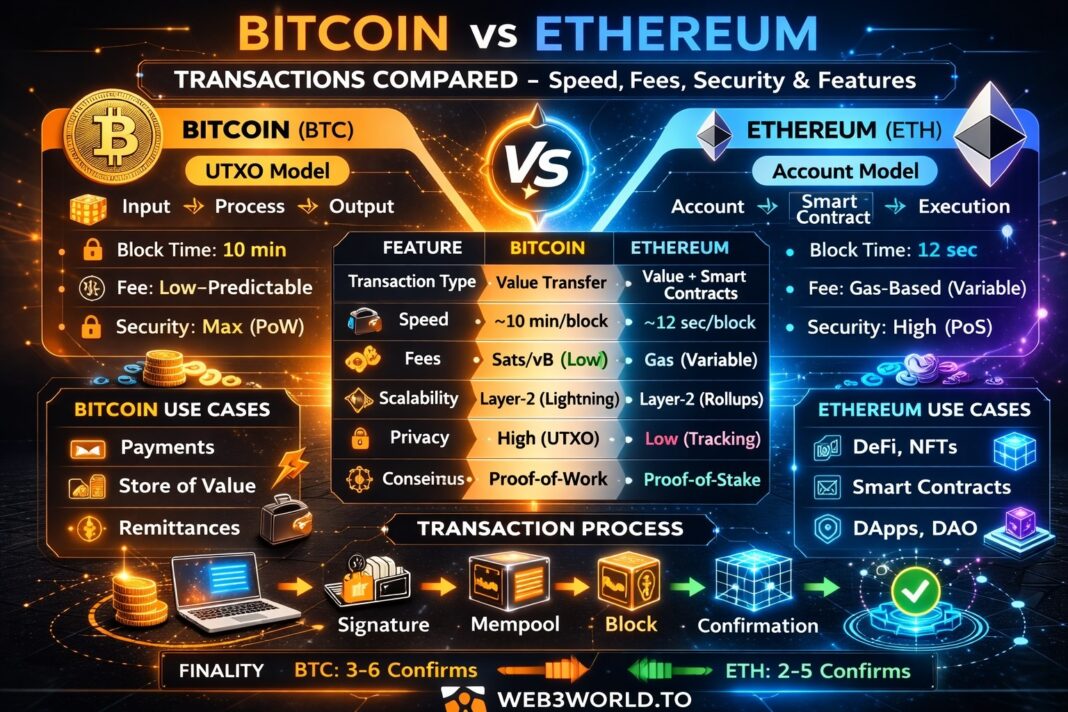
Although Bitcoin and Ethereum are often grouped together, their transaction systems work in fundamentally different ways.
Bitcoin is optimized for secure value transfer, while Ethereum is designed for programmable transactions and smart contracts. This article breaks down how transactions work on each network, where they differ, and which use cases they serve best.
Core Philosophy: Why Transactions Differ
| Network | Primary Goal |
|---|---|
| Bitcoin | Digital money & settlement |
| Ethereum | Programmable blockchain |
Bitcoin prioritizes immutability and simplicity.
Ethereum prioritizes flexibility and execution.
This philosophical split explains almost every transaction-level difference.
Transaction Model: UTXO vs Account-Based
Bitcoin: UTXO Model
Bitcoin uses Unspent Transaction Outputs (UTXOs).
- Each transaction consumes old outputs
- Creates new outputs
- No balances stored on-chain
Advantages:
- High security
- Easy parallel validation
- Strong privacy foundations
Tradeoff:
More complex transaction construction.
Ethereum: Account-Based Model
Ethereum uses accounts with balances.
- Each account has a balance and nonce
- Transactions update account state directly
Advantages:
- Simple logic
- Ideal for smart contracts
- Easier for developers
Tradeoff:
More global state = higher complexity and attack surface.
Transaction Structure Compared
| Feature | Bitcoin | Ethereum |
|---|---|---|
| Model | UTXO | Account |
| Smart contracts | Very limited | Native |
| State changes | No global state | Global state |
| Script execution | Minimal | Full virtual machine |
Fees: How Transaction Costs Work
Bitcoin Fees
- Based on transaction size (bytes)
- Measured in sats/vByte
- Market-driven via mempool demand
✔️ Predictable
✔️ No execution risk
Ethereum Fees (Gas System)
Ethereum transactions pay for:
- Computation
- Storage
- Contract execution
Fees = Gas Used × Gas Price
After EIP-1559:
- Base fee is burned
- Tip goes to validators
✔️ Flexible
❌ Can be unpredictable during congestion
Speed & Finality
| Metric | Bitcoin | Ethereum |
|---|---|---|
| Avg block time | ~10 minutes | ~12 seconds |
| Finality | Probabilistic | Faster, semi-final |
| Typical confirmations | 3–6 blocks | 2–5 blocks |
Ethereum is faster, but Bitcoin is more conservative and stable.
Smart Contract Transactions
Bitcoin
- Uses a restricted scripting language
- Not Turing-complete
- Focused on security
Use cases:
- Multi-signature
- Time locks
- Basic conditions
Ethereum
- Runs code via the Ethereum Virtual Machine (EVM)
- Fully programmable
- Enables DeFi, NFTs, DAOs
Use cases:
- Decentralized exchanges
- Lending protocols
- NFTs
- On-chain governance
Security Model
Bitcoin
- Proof-of-Work
- Extremely high cost to attack
- Minimal complexity reduces bugs
Ethereum
- Proof-of-Stake
- Economic penalties (slashing)
- Larger attack surface due to smart contracts
Both are secure — but secure in different ways.
Transaction Reversibility
| Network | Reversible? |
|---|---|
| Bitcoin | ❌ No |
| Ethereum | ❌ No |
Neither supports chargebacks.
However, Ethereum smart contracts can include recovery logic, while Bitcoin intentionally avoids this.
Privacy Considerations
Bitcoin
- Pseudonymous
- UTXO model helps privacy tools
- Coin control possible
Ethereum
- Account balances fully visible
- Easier to track user activity
- Privacy requires external solutions
Layer-2 Transaction Scaling
Bitcoin Layer-2
- Focus on payments
- Keeps base layer minimal
Ethereum Layer-2
- Rollups & sidechains
- Execute transactions off-chain
- Periodically settle on mainnet
Ethereum scales functionality, Bitcoin scales payments.
Which Transaction System Is Better?
It depends on use case:
Choose Bitcoin if you want
✔️ Maximum security
✔️ Store of value
✔️ Censorship resistance
✔️ Simple, robust transactions
Choose Ethereum if you want
✔️ Smart contracts
✔️ DeFi and NFTs
✔️ Complex on-chain logic
✔️ Fast settlement
Bitcoin and Ethereum are not competitors — they are complementary systems.
Bitcoin excels as digital money and settlement infrastructure.
Ethereum excels as programmable financial infrastructure.
Understanding their transaction models helps you:
- Choose the right network
- Avoid unnecessary fees
- Build smarter Web3 strategies
At Web3World.to, we focus on clarity over hype — real explanations for real users.
