
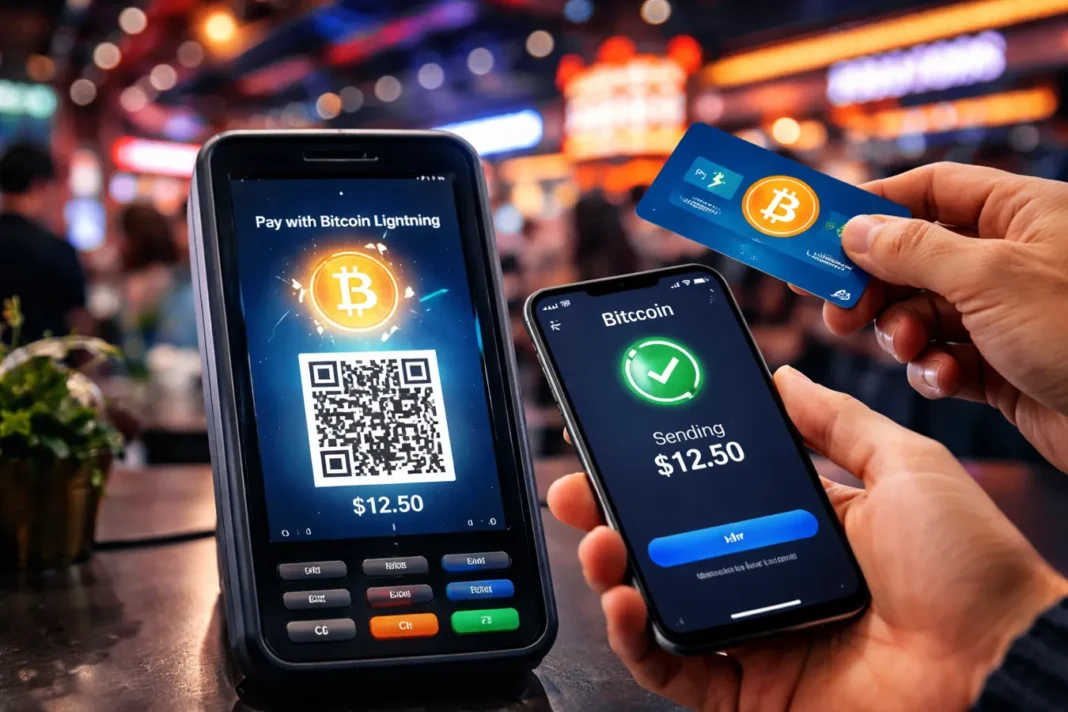
The Lightning Network has once again demonstrated its real-world potential after successfully processing more than 5,000 Bitcoin payments in just eight hours during a large-scale event held in Las Vegas.
This milestone highlights how Bitcoin’s layer-2 infrastructure is evolving from theory into practical, everyday payment technology — capable of handling fast, low-cost transactions in high-traffic environments.
Bitcoin’s Scaling Challenge and the Role of Lightning
While Bitcoin is widely recognized as a secure and decentralized digital asset, its base blockchain was never designed for high-frequency retail payments. On-chain transactions can be slow during peak demand and often come with higher fees, limiting their usability for everyday commerce.
The Lightning Network addresses this limitation by operating as a second-layer payment protocol, allowing users to transact off-chain while still relying on Bitcoin’s security. Transactions are settled almost instantly and cost only a fraction of traditional on-chain fees, making Lightning suitable for point-of-sale payments, ticketing, and live events.
Inside the Las Vegas Lightning Payment Demonstration
During the Las Vegas event, thousands of attendees used Lightning-enabled wallets to pay for goods and services in real time. Vendors accepted payments using simple tools such as QR codes and NFC-based payment cards, allowing even first-time Bitcoin users to complete transactions without technical complexity.
How payments worked on-site:
- Merchants entered prices in U.S. dollars
- A Lightning payment request was generated
- Attendees completed payments instantly via mobile wallets or NFC cards
- Transactions finalized in seconds with minimal fees
Notably, the system handled the full transaction load without outages or payment failures, reinforcing the network’s stability under real-world conditions.
Why This Event Matters for Bitcoin Adoption
Processing over 5,000 payments in a short time frame is more than a technical achievement — it’s a proof of usability. Historically, critics have questioned Bitcoin’s ability to function as “everyday money.” This event provides strong evidence that, with layer-2 solutions like Lightning, Bitcoin can support real-world commerce efficiently.
Unlike test environments or simulations, this demonstration involved:
- Live vendors
- Real customers
- Time-sensitive transactions
- No centralized payment processors
That combination makes the result especially meaningful for future adoption.
Beyond Micropayments: Lightning’s Expanding Use Cases
The Lightning Network was initially associated with small, low-value payments, but its capabilities are rapidly expanding. Recent activity shows that Lightning can support:
- High-volume retail payments
- Event ticketing systems
- Cross-border micro-commerce
- Select high-value transactions with minimal fees
As wallet usability improves and merchant tools mature, Lightning is increasingly positioned as a practical payment layer rather than an experimental feature.
Implications for the Web3 and Crypto Ecosystem
This Las Vegas event reflects a broader trend across the Web3 space: infrastructure is moving from speculation toward real utility. Fast, low-cost payments are essential for mass adoption, and Lightning provides a working solution without compromising Bitcoin’s decentralized foundation.
While Lightning is not yet competing directly with global payment giants in total volume, demonstrations like this show that the gap is narrowing — especially for niche markets, live events, and crypto-native commerce.
Final Thoughts
The successful processing of thousands of Bitcoin payments in just a few hours reinforces the idea that Bitcoin’s future is not limited to long-term holding or store-of-value narratives. With the Lightning Network, Bitcoin is increasingly capable of functioning as a practical digital payment system.
As adoption grows and user experience continues to improve, events like this may become the norm rather than the exception.
