
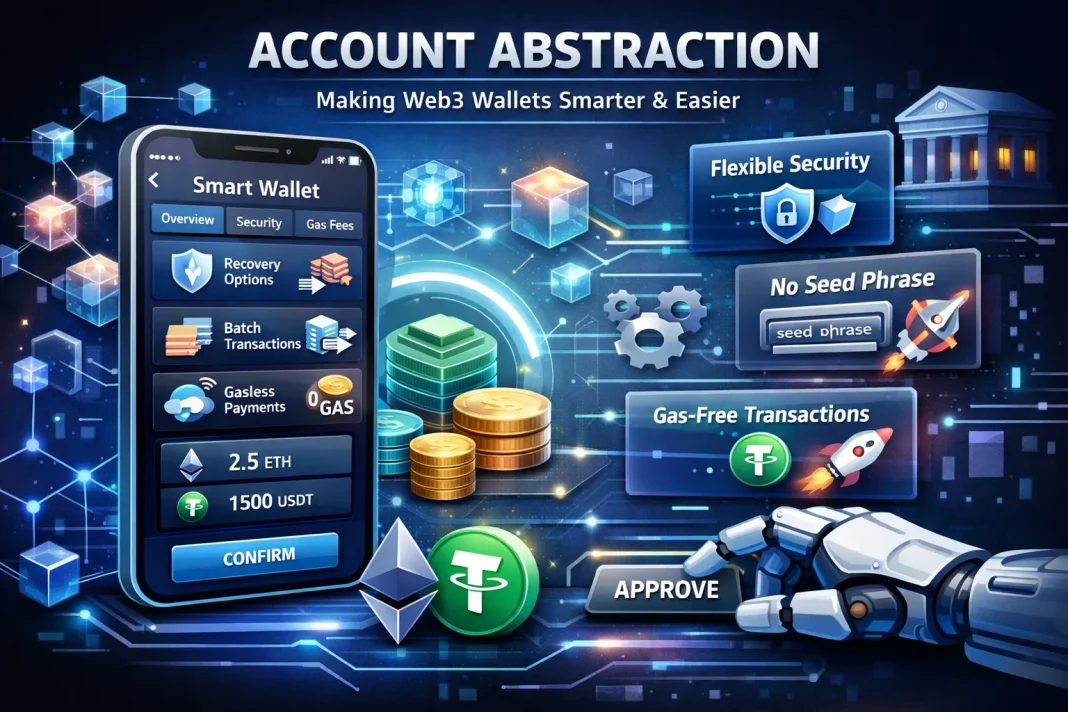
Web3 still has a usability problem. The technology is powerful, but for many normal users, wallets remain too technical. People are asked to save seed phrases, hold native gas tokens, approve multiple transactions, and understand networks before they can do something simple. Ethereum’s account abstraction roadmap says the current model makes batching difficult and requires users to keep ETH for fees, and presents account abstraction as a way to add better security and user experience to accounts.
If you want to understand the security foundation first, start with our Web3 wallet security guide. From there, account abstraction becomes easier to understand because it shows how wallets could evolve beyond the traditional one-key, one-account model. Your site already covers wallet security, nodes, scaling, AI, ETFs, and stablecoins, but smart wallets are still a missing educational topic in your visible recent content.
What Is Account Abstraction?
In simple terms, account abstraction means making wallets more programmable. Instead of relying only on traditional externally owned accounts, users can access Ethereum through smart contract wallets. Ethereum.org explains that this can happen either through upgrading EOAs with EIP-7702 or through a parallel transaction system built around EIP-4337. The result is the same general direction: smarter wallets with more flexible behavior.
That may sound technical, but the practical meaning is simple. A smart wallet can support more flexible security rules, account recovery, batching, and different fee-handling flows. Ethereum.org specifically lists benefits such as flexible security rules, recovery if keys are lost, and sharing account security across trusted devices or people.
Why Traditional Wallets Still Feel Hard
The traditional wallet model puts too much burden on the user. If someone loses a seed phrase, access can be gone forever. If they receive assets on a network but do not have the native gas token, they may be unable to move funds. If they want stronger security, they often need extra tools instead of built-in wallet logic.
That is why account abstraction matters. It brings features that feel normal in modern apps into wallet design. Instead of one fragile key controlling everything, the wallet can become a smarter account with rules, safeguards, and recovery systems built into it. This also connects with our guide to blockchain nodes and Web3 infrastructure, because wallets may look simple on the surface, but they depend on a deeper blockchain system working behind the scenes.
How ERC-4337 Works in Simple Language
ERC-4337 introduced a way to bring account abstraction to Ethereum without changing consensus. The standard is formally titled “Account Abstraction Using Alt Mempool”, and Ethereum.org describes it as a second, separate transaction system that runs in parallel to the existing protocol.
Instead of sending a normal transaction in the old style, users submit a different kind of request into the ERC-4337 flow. Under the hood, this allows smart wallets to plug in more flexible rules for validation, execution, and fee handling. For most readers, the technical structure matters less than the result: the wallet can do more while the experience feels simpler. Learn more in the official ERC-4337 documentation and the EIP-4337 specification.
Why Smart Wallets Could Become a Huge Web3 Trend
The biggest reason this matters is usability. Most users do not care about wallet architecture. They care whether they can sign in easily, recover access safely, and complete transactions without confusion.
1. Better onboarding
A smart wallet can reduce some of the friction that makes Web3 hard for first-time users. Ethereum’s account abstraction roadmap highlights that smart contract wallets can unlock better UX and more flexible account behavior. That makes onboarding feel more like using a modern app and less like entering a high-risk technical environment.
2. Better recovery
Recovery is one of the biggest weaknesses in the old wallet model. Ethereum.org explicitly lists account recovery as one of the user benefits unlocked by smart contract wallets. That means wallets can be designed around safer real-world recovery flows instead of relying only on a single seed phrase.
3. Gas abstraction
One of the most frustrating parts of crypto onboarding is needing the correct native gas token before doing anything useful. Ethereum.org specifically notes that the current system requires users to always keep an ETH balance to pay transaction fees, and presents account abstraction as a way to solve that problem. This is highly relevant to the broader payments discussion in our article on stablecoins vs SWIFT payments, because smoother fee handling and better wallet UX could help blockchain payments compete more effectively in real-world consumer and business use.
4. Transaction batching
Ethereum.org also points to batching as one of the things the current model makes difficult. That matters because many Web3 actions today require multiple confirmations. If smart wallets reduce that friction, DeFi, onboarding, and app interaction can become much more user-friendly.
5. Permissions and automation
As Web3 apps become more advanced, wallets need to do more than just hold assets. They need to manage limited permissions, app-specific controls, and recurring or delegated actions more safely. That also fits with the future described in our Internet of Agents guide, where machine-to-machine activity may need more flexible account logic than the old one-key wallet model can support.
Smart Wallets and the Future of Web3 UX
Safe describes smart accounts as a flexible account model, and its documentation explains that Safe smart accounts are smart contracts deployed on Ethereum-compatible networks rather than simple private-key accounts. That is a major shift in how wallets are designed. Instead of a wallet being only a key container, it becomes programmable account infrastructure. Read more in the official Safe smart accounts overview.
This shift may matter just as much as better scaling. If you have already read our guide to Layer-1 vs Layer-2 blockchains and our article on Web3 scaling, the next step is understanding that faster and cheaper transactions alone are not enough. Wallet usability matters too. Your site already emphasizes scaling and infrastructure topics, which makes account abstraction a strong next guide for readers moving deeper into Web3 fundamentals.
Risks and Trade-Offs
Account abstraction is powerful, but it is not magic. More logic in the wallet can also mean more design complexity. Because these systems rely on smart contracts and additional infrastructure, their safety depends on implementation quality, audits, and the exact trust model used by the wallet provider or app.
There is also an important trade-off between convenience and control. A wallet with easier recovery, sponsored fees, or delegated permissions may feel far better to use, but users still need to understand how much of the experience is fully self-custodial and how much depends on surrounding services or wallet design choices. That does not make smart wallets worse. It just means better UX still requires clear security thinking.
Why This Topic Matters Now
This topic matters because the industry is moving beyond pure infrastructure talk and focusing more on user experience. Ethereum.org’s account abstraction page was updated on February 23, 2026, which shows the subject remains active and current in the ecosystem. At the same time, your site’s recent visible content covers DeFi usage, NFTs, AI + Web3, stablecoins, ETFs, nodes, scaling, mining, and security, but not a dedicated deep guide to account abstraction. That makes this subject both timely and non-repetitive for Web3World.to.
Conclusion
Account abstraction could become one of the most important wallet upgrades in Web3 because it changes what a wallet can be. Instead of a fragile account controlled by one key and limited default behavior, a smart wallet can support better recovery, more flexible security, easier fee handling, and a smoother user experience.
That does not just improve convenience. It could remove some of the biggest reasons normal users still avoid crypto. If Web3 wants to reach a much larger audience, wallets need to feel less like cryptographic tools and more like secure modern accounts. Account abstraction is one of the clearest paths toward that future.
❓ FAQ
What is account abstraction in crypto?
Account abstraction is a wallet design approach that makes crypto accounts more flexible by allowing smart contract logic to control how the wallet works, including signing rules, recovery methods, batching, and fee handling.
What is ERC-4337?
ERC-4337 is the Ethereum standard that enables account abstraction through a separate transaction flow, allowing smart wallets to add advanced features without changing Ethereum’s base consensus.
What is the difference between a smart wallet and a normal wallet?
A normal wallet is usually controlled by one private key. A smart wallet is programmable, which means it can support features like social recovery, batched transactions, flexible permissions, and alternative fee handling.
Why does account abstraction matter?
It matters because it can make Web3 easier for normal users by reducing wallet friction, improving recovery options, and making transactions simpler and more intuitive.
Can smart wallets remove the need for seed phrases?
Some smart wallet designs can reduce reliance on seed phrases by using passkeys, backup signers, social recovery, or other authentication methods, depending on the wallet system.
Can smart wallets make gas fees easier to manage?
Yes. One of the biggest advantages of account abstraction is that it can support more flexible fee handling, including gas sponsorship or alternative payment flows, depending on the wallet design.
Are smart wallets safer than traditional wallets?
They can be safer in some ways because they support better recovery and custom security rules, but their safety still depends on the quality of the smart contract code, audits, and how the wallet is designed.
Is account abstraction only for Ethereum?
ERC-4337 is an Ethereum standard, but the broader idea of smarter programmable wallet accounts can influence other blockchain ecosystems as well.
Why is account abstraction important for mainstream adoption?
Because most new users struggle with seed phrases, gas fees, and confusing wallet flows. Account abstraction can make wallets feel more like modern apps and less like technical infrastructure.
Will account abstraction become standard in Web3?
It is still evolving, but many builders see it as one of the strongest paths toward better wallet UX, easier onboarding, and broader Web3 adoption.
